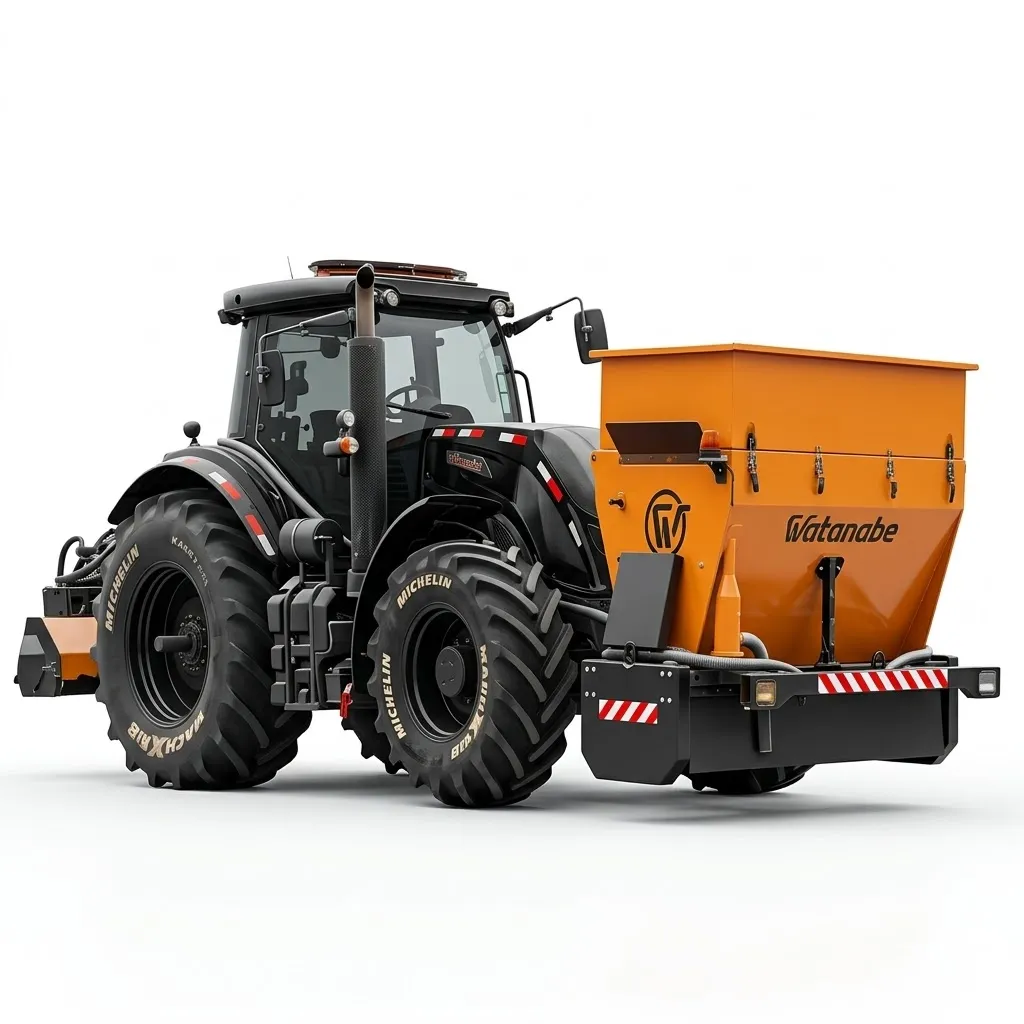
Description
The DCW 2.2 is a front-mounted binder spreader for large-scale soil stabilization — 1,300 kg, 2,140 mm working width, Cat 2/3 front linkage, selectable 1 m or 2 m application width, two internal precision rollers, integrated in-cab electronic control system. It distributes dry powder binders (lime, Portland cement) ahead of the tractor, allowing a stabilizing implement to follow immediately behind in the same pass — eliminating the separate spreading operation entirely.
Who the DCW 2.2 Is For
The DCW 2.2 is for road construction and rehabilitation contractors, aggregate plant operators, and civil engineering fleets running large-scale soil stabilization programs where binder application uniformity and operational efficiency directly affect project cost. It is designed as the direct precision replacement for manual bag-spread operations and older front-mounted spreading systems — particularly where uneven application, material waste, or the need for separate spreading and stabilization passes are the current operational bottleneck.
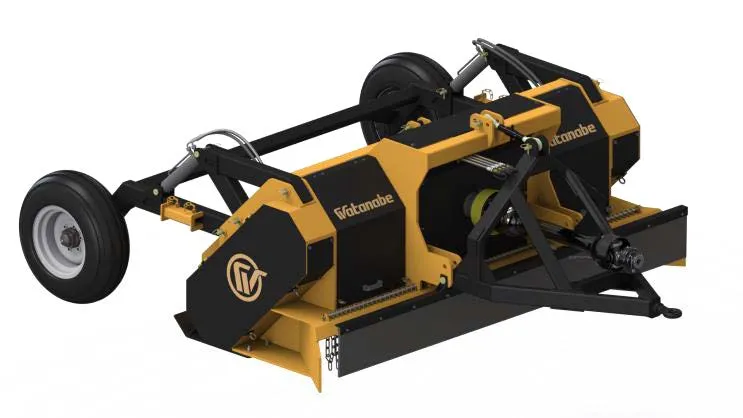
The front-mounted configuration pairs directly with a rear-mounted stabilizer such as the THOR ST Soil Stabilizer — the DCW 2.2 distributes lime or cement at the front, the stabilizer mixes it into the subgrade immediately behind, completing distribution and stabilization in one tractor pass. This is the core operational advantage over any two-pass system.
Technical Specifications
| Specification | DCW 2.2 |
|---|---|
| Model | DCW 2.2 — Ever-Power Brazil |
| Type | Front-Mounted Binder Spreader |
| Mounting | Tractor Front Linkage — Cat 2 or Cat 3 |
| Mandatory Weight | 1,300 kg |
| Working Width | 2,140 mm |
| Application Width (Selectable) | 2 m (full) or 1 m (single section) |
| Length — Option A | 1,780 mm |
| Length — Option B | 2,680 mm (larger hopper) |
| Height | 1,740 mm |
| Internal Rollers | Two high-precision partitioned rollers |
| Binder Compatibility | Lime, Portland Cement, dry powder binders |
| Control System | Integrated electronic — in-cab display, real-time dosage |
| Key Material | High-manganese MnCr2 steel (selected components) |
How the DCW 2.2 Works — Four Systems
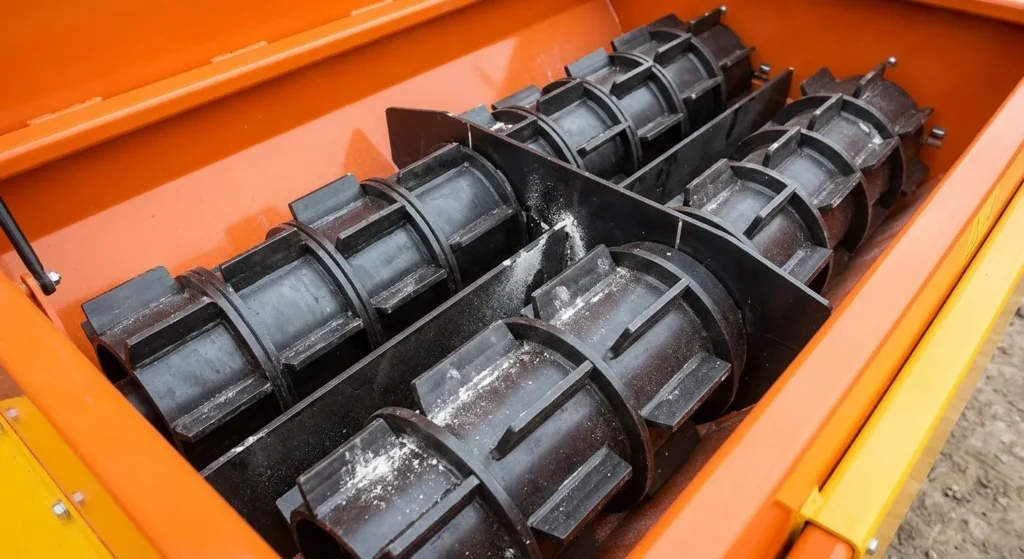
Mounting at the tractor’s front positions binder distribution ahead of the stabilizing implement. As the tractor moves forward, lime or cement is applied to the subgrade surface, and the rear stabilizer — a THOR ST or equivalent — immediately mixes it into the soil in the same pass. No second pass. No waiting. The operator has full forward visibility of the application zone throughout the operation.
The two high-precision partitioned internal rollers are the core of the DCW 2.2’s application control. Running both rollers together delivers the full 2 m application width. Running only one delivers a single 1 m section — essential for narrow lane applications, edge treatments near drainage or kerb, or variable road profiles where full-width application would waste binder or contaminate adjacent areas. Roller selection is controlled from the in-cab display.
The integrated electronic control system operates through a display unit mounted in the tractor cab. The system calculates the exact dosage in real time based on tractor forward speed — automatically adjusting roller output to maintain the target kg/m² as the tractor accelerates or slows. The operator can modify the target dosage rate directly from the cab seat without stopping. This eliminates the over- and under-dosing that characterises manual bag-spread operations at variable working speeds.
Selected components are manufactured from high-manganese MnCr2 steel for wear resistance against the abrasive flow of dry lime and cement powder. The system is designed exclusively for dry powder binders. Wet, damp, or clumped material clogs the internal rollers and prevents uniform application — material moisture content must be checked before loading.
Manual Bag-Spread vs DCW 2.2
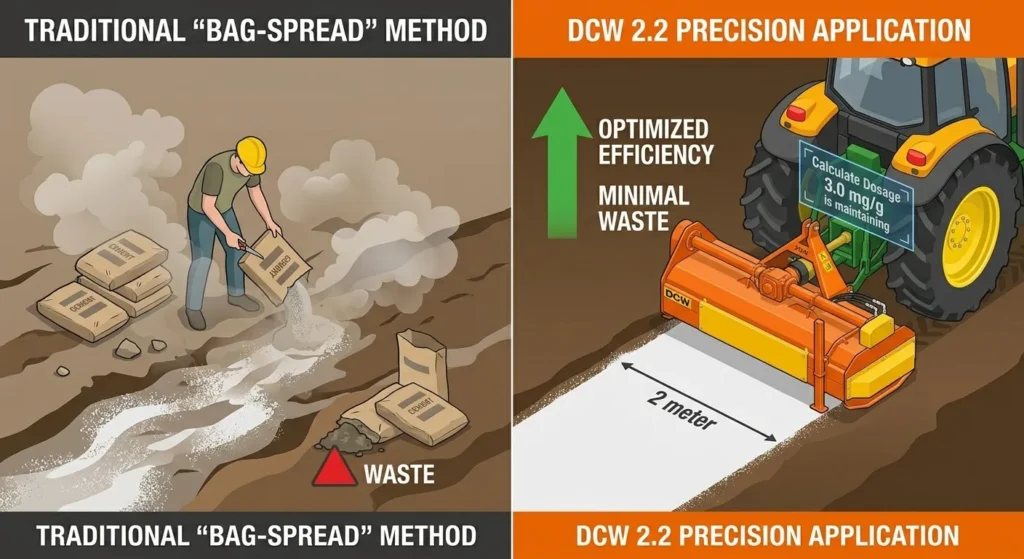
| Factor | Manual Bag-Spread | DCW 2.2 |
|---|---|---|
| Application Uniformity | Variable — operator-dependent | Speed-compensated electronic control |
| Application Width | Uncontrolled spread + drift | 1 m or 2 m — operator selected |
| Binder Waste | High — drift, over-application | Minimal — precision metering |
| Field Operations | 2 passes: spread then stabilize | 1 pass: spread + stabilize together |
| Labour Requirement | Multiple operators on foot | Single tractor operator |
| Dosage Adjustment | None — fixed by bag size | Real-time from cab display |
The bag-spread method produces uneven binder distribution that results in variable stabilization quality across the treated area — high-binder zones become over-stabilized and brittle, low-binder zones fail to achieve target bearing capacity. The DCW 2.2’s speed-compensated electronic metering eliminates this variability across the full project length.
Applications
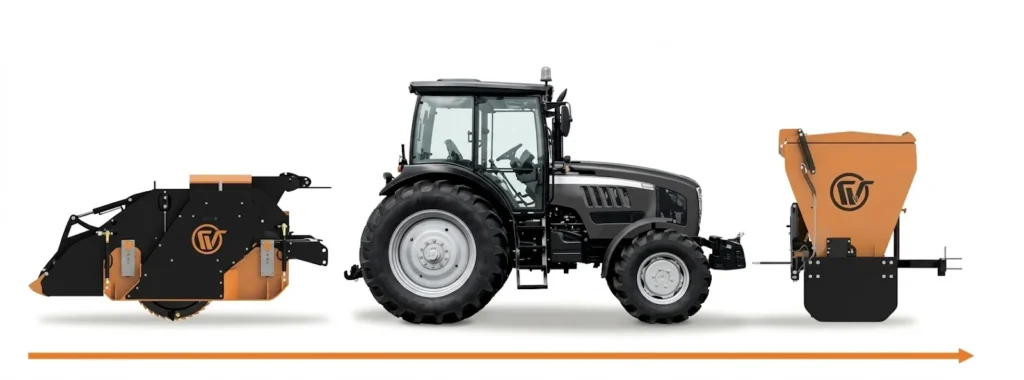
Large-scale road construction and rehabilitation projects where subgrade soils require chemical stabilization with lime or Portland cement before paving. The DCW 2.2 distributes binder uniformly at the specified rate ahead of the stabilizer — the single-pass combination delivers the target bearing capacity improvement consistently across the full project length without binder waste or application gaps.
Projects where only one lane requires stabilization, where edge zones need treatment without contaminating drainage channels or adjacent unpaved areas, or where the treatment area alternates between half-width and full-width sections. Single-roller 1 m mode eliminates the material waste and surface contamination that full-width spreading causes when only partial coverage is required.
The DCW 2.2 is engineered as a direct-fit replacement for front-mounted spreading systems using the same 2,140 mm working width and 1,300 kg mandatory weight parameters — minimizing installation downtime when replacing older or out-of-support systems. Cat 2/3 front linkage compatibility covers the full range of commercial stabilization tractors in current fleet use.
Aggregate plant operations requiring controlled binder addition to processed material before or during compaction — where the in-cab electronic dosage control ensures consistent binder-to-aggregate ratios across production batches. The MnCr2 steel components resist the abrasive flow of cement and lime powder in continuous-operation plant environments where wear rate is the primary maintenance variable.
Installation Overview
Mount the DCW 2.2 to the tractor’s front three-point linkage (Cat 2 or 3). Confirm alignment and torque on all linkage pins before proceeding.
Connect hydraulic hoses to the tractor’s front SCV ports — these power the internal rollers and sectional shut-off gates for 1 m / 2 m width selection.
Mount the control system display inside the tractor cab and route the communication cable to the spreader unit.
Set application width (1 m or 2 m) and enter target dosage rate in the cab display. The system calibrates automatically against tractor forward speed.
Perform a short dry run to verify dosage precision against forward speed before starting live binder application. Confirm material is fully dry before loading.
Before You Order
| Question | Why It Matters |
|---|---|
| Tractor front linkage — Cat 2 or 3? | The DCW 2.2 mounts on the tractor front three-point hitch. Confirm Category (2 or 3) and front linkage lift capacity rated for 1,300 kg before ordering. |
| Front SCV hydraulic ports available? | The internal roller drive and sectional gates require front SCV hydraulic connection. Confirm port availability and flow rate on your tractor model. |
| Length option — A (1,780 mm) or B (2,680 mm)? | Option A is the compact variant — better for tight site access and shorter project runs. Option B gives a larger hopper for extended runs without refilling. Confirm site access constraints before selecting. |
| Binder material — dry and free-flowing? | The DCW 2.2 is designed exclusively for dry powder binders. Damp, wet, or clumped lime or cement blocks the internal rollers. Verify material moisture content and storage conditions before loading. |
| Rear stabilizer available for single-pass operation? | Single-pass efficiency requires a rear-mounted stabilizer (THOR ST or equivalent) running simultaneously. Without a rear stabilizer, two separate passes are still required — the DCW 2.2 still improves application uniformity, but the single-pass benefit requires both machines running together. |
Related Products

What Buyers Say
“We run road rehabilitation contracts across three states. The DCW 2.2 replaced our manual bag-spread crews entirely. The in-cab display makes real-time dosage adjustment straightforward — when the tractor slows at intersections, the system compensates automatically. We have seen measurably more consistent stabilization results across project lengths since switching, and our lime consumption per km has dropped because we are no longer over-applying to compensate for uneven distribution.”
“The 1 m single-roller mode is the feature that sold us on the DCW 2.2. We do a lot of edge lane work where the full 2 m width would contaminate the drainage channel — the ability to switch to one roller from the cab without stopping is exactly what we needed. The front-mounted system paired with our THOR ST behind gives us a genuine single-pass operation. Installation was straightforward on our Cat 3 front linkage.”
“Very precise spreader — application uniformity is clearly better than our old system. Four stars because we had a roller blockage in the second week from partially damp cement that had absorbed moisture during overnight storage. Ever-Power was clear in the manual that dry material is mandatory — we had not controlled our storage conditions carefully enough. Once we improved our binder storage and confirmed material is fully dry before loading, no further blockages across the rest of the contract.”
About India Watanabe
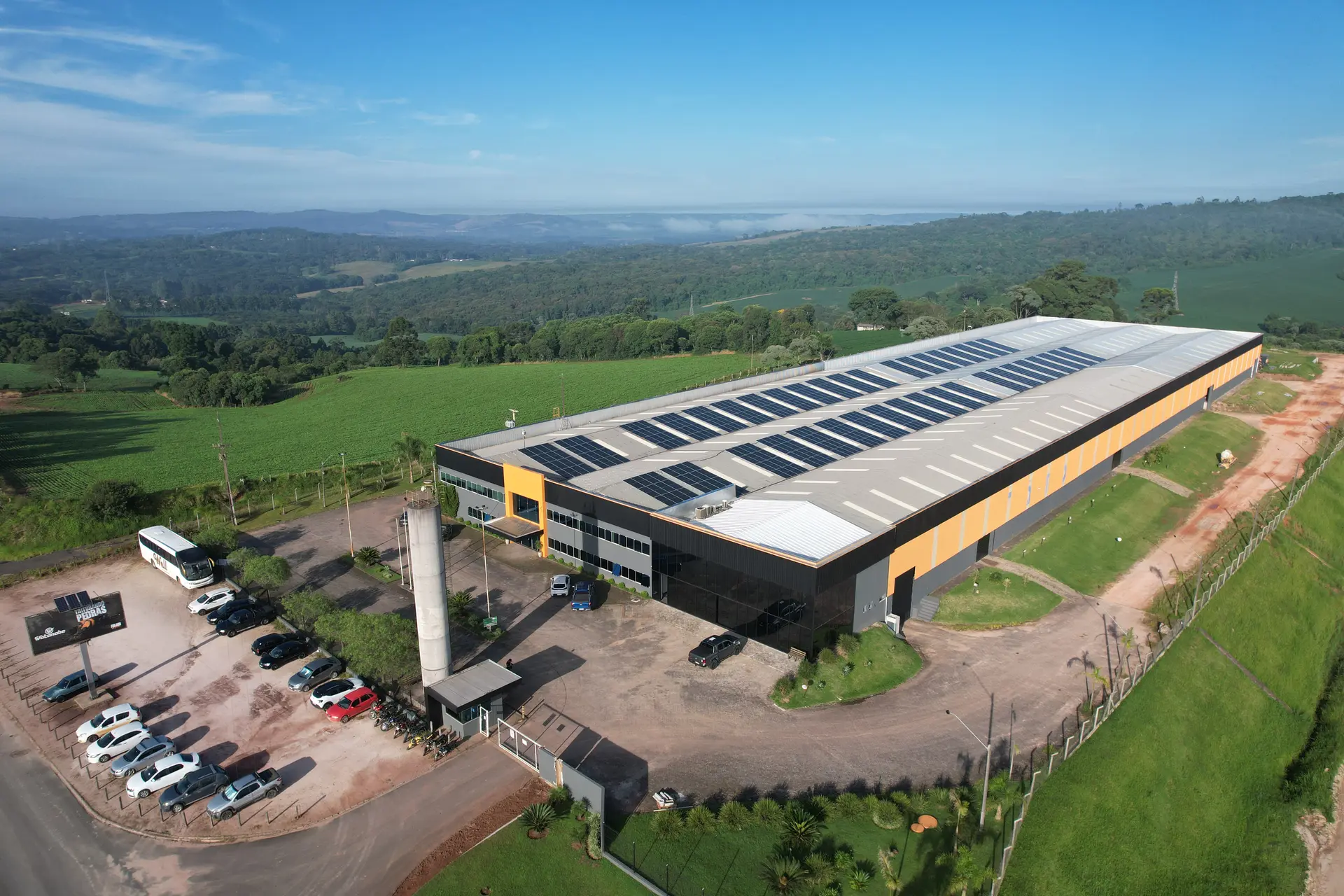

India Watanabe Soil Stabilizer Co.,Ltd supplies commercial soil stabilization and road construction equipment to contractors, plant operators, and infrastructure fleets across India. B2B only — we do not accept 1–2 piece retail orders.
Block No.3,4 & 5, Udyog Bhavan, GH Rd,
Sector 11, Gandhinagar, Gujarat, India.
B2B Enquiries Only
Request a Quote for the DCW 2.2
Tell us your tractor linkage category, length option, binder type, and daily area — we respond within 24 hours.


















Reviews
There are no reviews yet.