● Materials Reference
What Materials Are Used for Soil Stabilization?
The choice of stabilization material is the most consequential decision in any soil stabilization project. Get it right and you have a durable, cost-effective layer that performs for decades. Get it wrong — cement on a high-PI clay, or lime on a sulphate-bearing sand — and you get an expensive failure. This guide covers every material used for soil stabilization: what it is, how it works, which soils it suits, and the typical quantities involved.
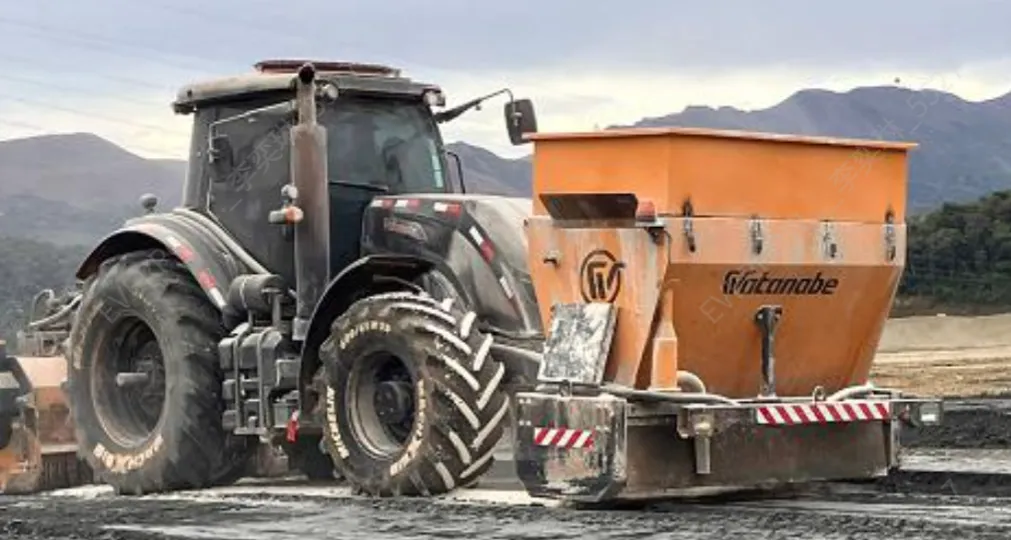
Overview: The Full Range of Stabilization Materials
Soil stabilization materials fall into six broad categories: cementitious binders, calcareous binders, pozzolanic materials, bituminous binders, chemical stabilizers, and physical/fibre reinforcement. Each category works through a different mechanism, and within each category there are multiple specific products. The right material depends on the soil type, the target performance, the available budget, and the project timeline.
| Material | Category | Best Soil Type | Typical Rate |
|---|---|---|---|
| Portland Cement (OPC) | Cementitious | Granular, silt, low-PI clay | 3–14% |
| Quicklime (CaO) | Calcareous | High-PI clay, Black Cotton Soil | 3–6% |
| Hydrated Lime (Ca(OH)₂) | Calcareous | High-PI clay | 4–8% |
| Fly Ash (Class C / Class F) | Pozzolanic | All types (with activator for F) | 10–25% |
| GGBS (Ground Granulated Blast Furnace Slag) | Pozzolanic / latent hydraulic | All types (with lime activator) | 5–20% |
| Foamed Bitumen | Bituminous | Granular, recycled pavement | 2–4% |
| Bitumen Emulsion | Bituminous | Granular, sand | 3–6% |
| Calcium Chloride | Chemical | Granular, fine-grained | 0.5–2% |
| Synthetic Polymer | Chemical | Silty clay (site-specific) | Proprietary |
| Geotextile / Geogrid | Physical reinforcement | Soft clay, weak subgrade | As designed |
| Polypropylene / Steel Fibres | Fibre reinforcement | Cement-stabilized layers | 0.1–0.5% |
1. Cementitious Binders
Portland Cement (OPC / PPC / PSC)
Portland cement is the most widely used stabilization material in the world. When mixed with moist soil, it hydrates to form calcium silicate hydrate (CSH) and calcium aluminate hydrate (CAH) crystals that bind soil particles into a rigid cementitious matrix. Strength gain is fast — significant UCS at 7 days — and the improvement is permanent and moisture-independent.
OPC (Ordinary Portland Cement) is the standard grade. PPC (Portland Pozzolana Cement) contains fly ash and produces less heat of hydration, extending the working time slightly — advantageous in hot Indian conditions. PSC (Portland Slag Cement) contains GGBS and offers better sulphate resistance than OPC. For sulphate-bearing soils, PSC or sulphate-resistant cement (SRC) is preferred over OPC.
Typical application rate: 3–5% for granular soils, 7–14% for silts and low-PI clays. Rate determined by laboratory mix design targeting UCS of 1.5–3.0 MPa at 7 days (IRC:SP:89). Not suitable for high-PI clays (PI > 20) or organic soils (OC > 2%) without pre-treatment.
Rapid-Hardening Cement (RHC)
A Portland cement variant with a finer grind and higher C₃S content that achieves 3-day strength equivalent to OPC 28-day strength. Used when the project timeline requires the stabilized layer to be opened to traffic or overlaid with pavement sooner than normal. Higher cost than OPC limits its use to time-critical projects.
2. Calcareous Binders (Lime)
Quicklime (Calcium Oxide, CaO)
Quicklime is the most reactive form of lime and the preferred material for treating wet, high-PI clay soils including Black Cotton Soil. When quicklime contacts soil moisture, it undergoes an immediate exothermic slaking reaction (CaO + H₂O → Ca(OH)₂ + heat), releasing significant heat that drives off moisture and rapidly reduces the soil’s water content. This immediate drying effect makes quicklime the only practical material for making wet, sticky clay workable enough to mix and compact on site.
Following the initial drying reaction, Ca(OH)₂ produced by slaking reacts with clay minerals through ion exchange — calcium ions replace sodium and hydrogen ions on clay particle surfaces — immediately reducing plasticity. The long-term pozzolanic reaction between Ca(OH)₂ and reactive silica and alumina in the clay produces CSH, progressively building strength over weeks and months.
Typical rate: 3–6% by dry soil mass. Handling requires full PPE — quicklime is caustic and generates heat. Governed by IRC:SP:89 for road applications in India.
Hydrated Lime (Calcium Hydroxide, Ca(OH)₂)
Hydrated lime is quicklime that has already been slaked with water before delivery to site. It does not generate heat on contact with soil moisture, making it safer and easier to handle than quicklime. It is less reactive than quicklime and does not provide the immediate drying effect, so it is less suitable for very wet soils. For moderately plastic clays at acceptable moisture content, hydrated lime provides equivalent long-term pozzolanic reaction to quicklime at slightly higher application rates (4–8% vs 3–6% for quicklime).
Lime Slurry
A suspension of hydrated lime in water, applied as a liquid. Used when dust control is a concern (residential areas, dry windy conditions) or when more uniform distribution is required than dry powder spreading. Lime slurry injection is also used for deep in-place stabilization of subgrade soils through pressure injection into cracks and boreholes — a specialist technique for reactive clay management beneath existing pavements.
3. Pozzolanic Materials
Fly Ash (Pulverised Fuel Ash)
Fly ash is a fine, glassy powder collected from the flue gases of coal-fired power stations. India produces over 200 million tonnes of fly ash annually from its thermal power plants — making it a cost-effective and widely available stabilization supplement. Its performance depends on its classification:
- Class C fly ash (high-calcium, from sub-bituminous/lignite coal) — Contains sufficient calcium oxide to react self-cementitiously. Can be used as a standalone stabilizer or mixed with lime. Common in western and northern India.
- Class F fly ash (low-calcium, from bituminous coal) — Pozzolanic but not self-cementing. Requires a calcium activator — lime or cement — to react. Most Indian fly ash is Class F. Used at 10–25% combined with 3–5% lime or cement.
Fly ash reduces overall binder cost, improves workability (its spherical particles act as ball bearings, reducing mixing energy), lowers permeability, and in some combinations extends the working time — valuable in hot Indian conditions where the 2-hour cement compaction window is a field management challenge.
Ground Granulated Blast Furnace Slag (GGBS)
GGBS is a latent hydraulic binder produced by rapidly quenching molten iron slag with water, then grinding it to a fine powder. It reacts with calcium hydroxide (from lime or cement hydration) to form CSH — the same compound responsible for cement stabilization strength. GGBS offers several advantages over fly ash: higher reactivity, better sulphate resistance, lower permeability in the cured product, and higher long-term strength. It is increasingly used as a 20–50% replacement for cement in stabilization blends, reducing both cost and carbon footprint.
Rice Husk Ash (RHA)
An agricultural by-product produced by burning rice husks at controlled temperatures. RHA contains 85–95% silica in a reactive amorphous form that reacts with lime to produce CSH. It is particularly relevant in India — the world’s second-largest rice producer — where large quantities are available near agricultural processing areas. Research has demonstrated that RHA at 5–15% combined with lime at 3–5% can achieve UCS values of 0.5–1.5 MPa on Black Cotton Soil — a sustainable, low-cost combination for rural road subgrade improvement in rice-growing regions.
4. Bituminous Binders
Foamed Bitumen
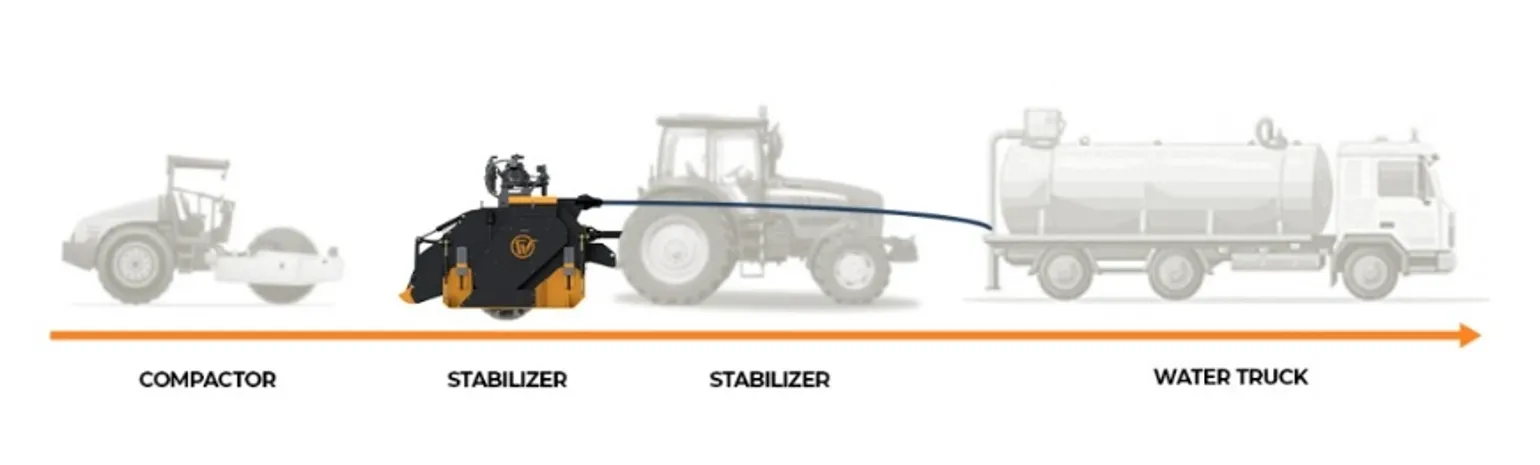
Foamed bitumen is produced by injecting a small quantity of cold water and air into hot bitumen (160–180°C), causing it to expand into a foam with up to 20 times its original volume. This foam is injected directly into the mixing chamber of the stabilizer machine, where it disperses as fine bitumen droplets throughout the milled soil. Unlike hot-mix asphalt, foamed bitumen stabilization is a cold-mix, in-place process that requires no heating plant on site.
Foamed bitumen does not cement soil particles together — instead, it coats individual particles and cluster interfaces with a waterproof film, preventing moisture from entering the soil matrix. The result is a flexible, moisture-resistant base layer that does not suffer from the shrinkage cracking associated with cementitious stabilization. It is best suited to granular soils and recycled pavement materials with some fines content (3–12% passing 75 μm) to provide cohesion during construction. Typical rate: 2–4% by mass of treated material.
Bitumen Emulsion
Bitumen emulsion is bitumen dispersed in water using an emulsifying agent, forming a stable liquid at ambient temperature. When mixed into soil, the water evaporates and the bitumen droplets coalesce to coat soil particles. It is easier to apply than foamed bitumen (no heating required, applied as a spray) but takes longer to break and develop strength. Suitable for granular soils and sand stabilization. Often used in combination with a small quantity of cement (1–2%) to accelerate emulsion break and provide additional cohesion during construction.
5. Chemical Stabilizers
Calcium Chloride (CaCl₂)
Calcium chloride is a hygroscopic salt that absorbs moisture from the atmosphere and retains it in the soil pores, keeping the treated layer at near-optimum moisture content and reducing dust generation. It does not create cementitious bonds — its primary effect is moisture retention and surface stabilization. Used at 0.5–2% for dust control on unpaved roads and gravel surfaces, and as a compaction aid on granular subgrades. Also used to accelerate cement hydration in cold weather applications.
Sodium Silicate (Water Glass)
Sodium silicate reacts with calcium ions in the soil to precipitate silica gel, which fills soil pores and binds particles. Used primarily in grouting applications for permeation grouting of fine sands — injected under pressure to stabilize loose sand around excavations, tunnels, and foundations. Not used for surface mixing stabilization. Requires careful pH management, as the reaction is sensitive to soil chemistry.
Synthetic Polymers (Acrylic, Polyacrylamide)
Liquid polymer stabilizers are mixed into soil to modify clay particle surface charge and improve aggregate stability. Polyacrylamide (PAM) at very low rates (0.001–0.01%) is widely used in agriculture and erosion control — it improves aggregate stability, reduces surface crusting, and controls erosion without adding structural strength. Higher-concentration polymer stabilizers are used for construction applications, improving compaction and reducing plasticity of silty clays. Results are highly soil-specific and require site trials before specification.
Ionic Stabilizers and Enzyme-Based Products
A range of proprietary liquid products work by modifying clay particle surface chemistry through ionic substitution or enzymatic catalysis. Claims for these products vary widely, and independent verification is limited for many commercial formulations. They are best suited to low-to-moderate plasticity silty clays and are not appropriate for high-PI soils where lime or cement treatment is the established standard. Always request independently verified test data before specifying proprietary chemical stabilizers.
6. Physical Reinforcement Materials
Geotextiles and Geogrids
Geosynthetics placed at the interface between a weak subgrade and an overlying granular layer provide separation (preventing clay contamination of the aggregate), filtration (allowing water to drain while retaining fines), and reinforcement (distributing applied load over a wider area of subgrade). Geogrids interlock with aggregate particles to provide in-plane tensile resistance, increasing the effective bearing capacity of the system. These are improvement materials — not stabilization materials — because they do not alter the properties of the subgrade itself. They are used alongside chemical stabilization on very soft subgrades or as a cost-effective alternative where chemical treatment is impractical.
Polypropylene and Steel Fibres
Short polypropylene or steel fibres mixed into cement-stabilized soil at 0.1–0.5% by volume improve post-crack behaviour — they bridge developing cracks and resist their opening, reducing both the width of shrinkage cracks and the risk of brittle fracture under traffic loading. Research in India and internationally has demonstrated that fibre addition to cement-stabilized Black Cotton Soil reduces shrinkage cracking by 30–60% compared to plain cement stabilization at the same cement content. Fibres are mixed in with the binder during the stabilizer machine pass.
Natural Fibres (Jute, Coir, Sisal)
Natural fibres mixed into clay soils improve tensile strength and reduce shrinkage cracking in a similar way to synthetic fibres, but biodegrade over time — making them appropriate for temporary stabilization or for applications where the soil will eventually be worked again (agricultural land). Jute and coir are abundantly available in India and have been researched extensively as low-cost stabilization supplements for rural road construction. Coir geotextiles are also widely used for slope erosion control across India’s monsoon-affected terrain.
Selecting the Right Material: A Decision Framework
Material selection follows directly from soil investigation results. This framework covers the most common Indian site conditions:
- Black Cotton Soil / high-PI clay (PI > 25) — First choice: quicklime at 3–6%. If structural strength also required: lime first, then cement. Add Class F fly ash at 10–15% to reduce lime or cement cost after PI is reduced. Rice husk ash is a viable low-cost substitute for fly ash in rice-growing regions.
- Sandy soil or coarse silt (PI < 10) — First choice: OPC at 5–9%. Add fly ash at 10–20% to reduce cost. Foamed bitumen is an alternative where flexibility is preferred over rigidity.
- Granular soil or recycled road base — Foamed bitumen at 2–4% (flexible, no shrinkage cracking) or OPC at 3–5% (rigid, higher bearing capacity). Add 1–2% cement to foamed bitumen mixes for improved cohesion during construction.
- Sulphate-bearing soil (SO₃ > 0.5%) — Do not use OPC or lime alone. Specify PSC, SRC, or GGBS-lime combination. Test for ettringite expansion before finalising design.
- Organic soil (OC > 2%) — Cement and lime both perform poorly in organic soils. Consider removal and replacement, or specialist proprietary stabilizers with site-specific trial mixes before committing to a design.
Frequently Asked Questions
QWhat is the most commonly used material for soil stabilization?
Portland cement and lime are the two most widely used stabilization materials globally and in India. Cement dominates for granular soils and low-PI clays; lime is the primary choice for high-PI clays including Black Cotton Soil. Fly ash is the most common supplementary material, added to both cement and lime mixes to reduce cost and improve workability.
QCan fly ash be used alone without lime or cement?
Class C fly ash (high calcium) can be used alone as it is self-cementing, but it is less common in India where Class F (low calcium) fly ash predominates. Class F fly ash must be activated with lime or cement. In both cases, using fly ash alone — without a co-binder — typically produces lower UCS and slower strength gain than combining it with OPC or lime, making it suitable mainly for low-strength applications or as a supplement rather than a primary binder.
QIs rice husk ash (RHA) effective for soil stabilization in India?
Yes — when properly processed (burned at 500–700°C and ground to a fine powder), RHA contains 85–95% reactive amorphous silica that reacts effectively with lime. Studies from IITs and state highway departments in Maharashtra, Andhra Pradesh, and Tamil Nadu have demonstrated UCS values of 0.5–1.5 MPa on Black Cotton Soil treated with lime-RHA combinations. It is a viable low-cost option in rice-producing regions but requires controlled processing to produce consistent reactive silica content.
QWhen should I use foamed bitumen instead of cement?
Foamed bitumen is preferred when the treated layer needs to be flexible (not rigid), when shrinkage cracking must be avoided, when the project involves recycling an existing asphalt pavement, or when the treated layer will be opened to traffic quickly without a curing period. Cement stabilization is preferred when high UCS is required, when the layer will carry heavy structural load, or when a rigid foundation for a thick asphalt surface is needed.
QDo all stabilization materials require the same mixing equipment?
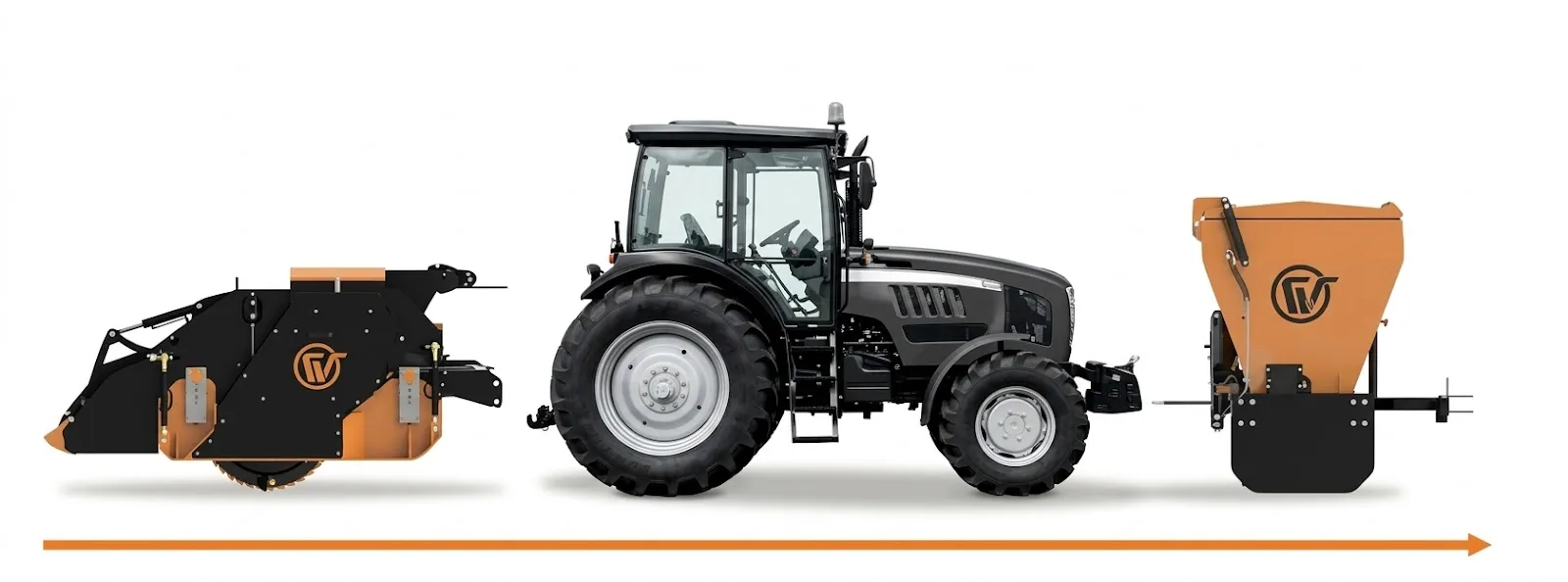
All in-situ surface stabilization with dry powder binders (cement, lime, fly ash, GGBS) requires a rotary soil stabilizer machine. Foamed bitumen requires a stabilizer machine with an integrated foaming system. Bitumen emulsion can be mixed with a stabilizer machine or, for smaller projects, a recycler. Grouting materials (sodium silicate, polyurethane) require injection equipment, not a surface stabilizer. Geosynthetics require only earthmoving equipment for placement.
Key Takeaways
- Six material categories: cementitious, calcareous (lime), pozzolanic, bituminous, chemical, and physical reinforcement — with 15+ specific materials across them
- Portland cement and quicklime are the two primary stabilization materials globally — cement for granular/low-PI soils, lime for high-PI clays
- India’s 200+ million tonnes of annual fly ash output makes it the most cost-effective supplementary material for both lime and cement stabilization projects
- Foamed bitumen is the best choice for flexible stabilization of granular soils and recycled pavement — no shrinkage cracking, no curing window constraint
- Rice husk ash + lime is a promising low-cost, sustainable alternative for Black Cotton Soil stabilization in India’s rice-growing regions
The right stabilization material for your project depends on your soil, your performance target, your budget, and your timeline. The THOR ST Soil Stabilizer from インド渡辺土質安定剤株式会社 is compatible with all dry powder and liquid chemical stabilization materials — cement, lime, fly ash, GGBS, and foamed bitumen — giving you the flexibility to match the machine to the material specification. Contact our team to discuss your material requirements and equipment options.