Soil Stabilization Guide
What Is the Most Commonly Used Material for Soil Stabilization?
Portland cement is the most commonly used material for soil stabilization worldwide, used in more projects across more soil types and climate conditions than any other binder. In India specifically, quicklime is equally important — for the 60 million hectares of Black Cotton Soil across the Deccan Plateau, lime is not an alternative to cement but an essential prerequisite without which cement stabilization will fail. The two materials work together as a system.
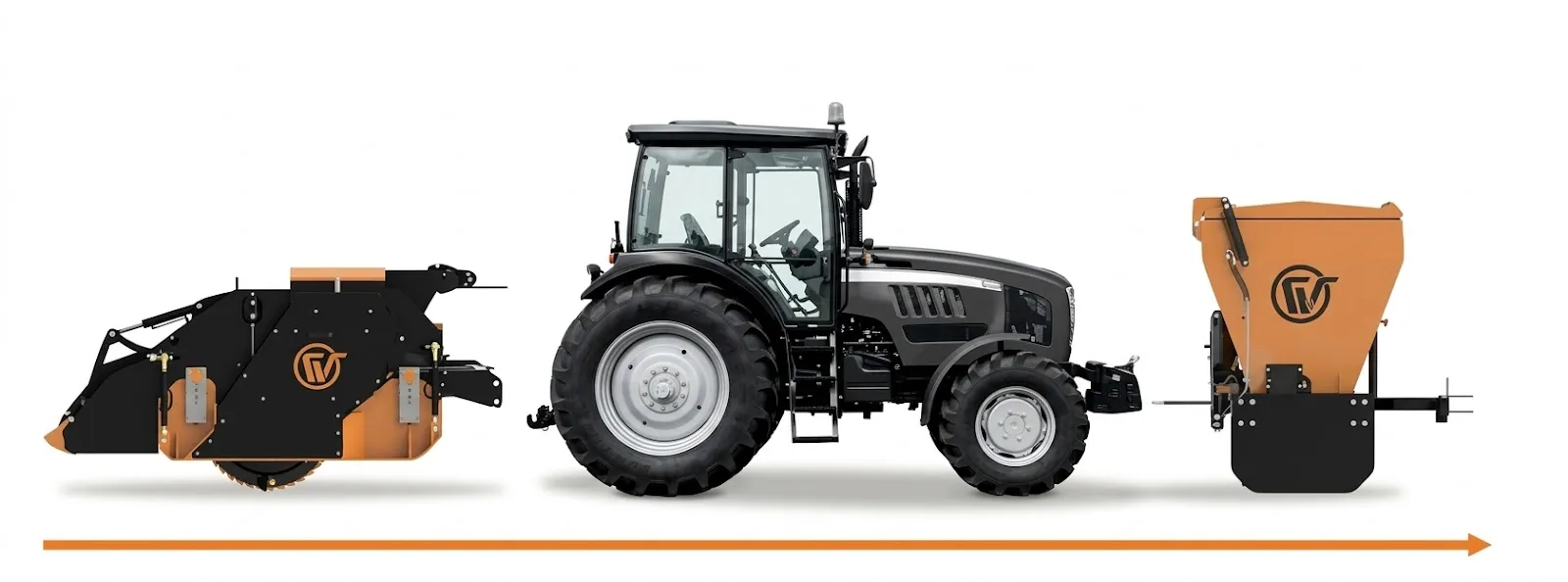
DCW 2.2 applying lime — the most important material for Black Cotton Soil stabilization in India
The Five Main Soil Stabilization Materials
1. Portland Cement — The Global Standard
Portland cement is the single most widely used soil stabilization material globally. Its advantages are consistent quality (manufactured to IS standards with strict production controls), availability everywhere in India (no project is more than a day’s transport from a cement depot), predictable 7-day strength development (matching IRC:SP:89’s acceptance criteria timeline), and a proven track record across decades of road construction in every climate zone.
Cement stabilization works by forming calcium silicate hydrate (CSH) and calcium aluminate hydrate (CAH) crystals that permanently bond soil particles together. At 5–9% OPC by soil mass, it achieves soaked UCS of 1.5–5.0 MPa — meeting the full range of IRC:SP:89 structural stabilization requirements. Strength gain is rapid: 70–80% of 28-day strength is achieved at 7 days with OPC.
- Best for: Low to medium plasticity soils (PI < 25), granular soils, full depth reclamation of failed asphalt roads, industrial platforms. Full equipment details at soil-stabilisor.com/soil-stabilizer/
- Not suitable for: Black Cotton Soil with PI > 25 without lime pre-treatment first; sulphate-bearing soils (SO₃ > 0.5%) without specifying PSC or SRC
2. Quicklime — Essential for Indian Black Cotton Soil
For India’s vast Black Cotton Soil regions — Maharashtra, Karnataka, Madhya Pradesh, Telangana, and Andhra Pradesh — quicklime (CaO) is not merely an alternative binder to cement. It is an essential prerequisite without which cement stabilization cannot achieve its design performance on high-plasticity clay.
Quicklime achieves its effects through two mechanisms. First, it reacts exothermically with water in the soil, releasing heat that dries wet clay — making it workable for mechanical mixing operations that would otherwise be impossible in wet, plastic Black Cotton Soil. Second, and more permanently, calcium ions from the dissolved lime replace sodium and hydrogen ions on the clay mineral surface through cation exchange. This ion exchange permanently modifies the clay’s mineralogy, reducing its plasticity index from 40–60 to below 20, eliminating its expansive behaviour, and making it receptive to cement stabilization.
Why Lime Cannot Be Skipped on Black Cotton Soil
Cement alone on PI > 25 Black Cotton Soil produces a layer that looks complete but fails within 1–2 monsoon cycles. The unmodified expansive clay continues to swell and shrink seasonally, progressively breaking the cement matrix. Lime pre-treatment is the only intervention that permanently overcomes BCS expansion — making it the most critical soil stabilization material for the most widespread problem soil in India.
Material Selection for Specific Indian Soil Conditions
The correct stabilization material depends on your specific soil properties — particularly plasticity index, sulphate content, and organic content. The table below guides material selection for the most common Indian soil types encountered in road construction.
| Soil Type | PI | SO₃ | First Choice Material | Second Stage | Anmerkungen |
|---|---|---|---|---|---|
| Sandy / granular (IS Zone I-II) | < 10 | < 0.5% | OPC 43 grade (4–6%) | None needed | Single-stage; fastest construction |
| Alluvial silt (Gangetic Plain) | 10–20 | < 0.5% | OPC 43 grade (5–7%) | None needed | Good early strength with OPC |
| Black Cotton Soil (Deccan) | 25–60 | < 0.5% | Quicklime (4–6%) | OPC/PPC (4–7%) | Two-stage mandatory; lime reduces PI first |
| BCS with sulphates | 25–60 | 0.5–1.5% | Quicklime (4–6%) | PSC (5–8%) | PSC replaces OPC in second stage |
| Laterite (coastal/Ghats) | 15–30 | < 0.5% | OPC or PSC (4–7%) | None needed | Check for sulphates near coast |
| Marine clay (coastal) | 30–60 | 0.5–2.0% | Quicklime (5–8%) | PSC or SRC | High sulphate risk — test first |
Future Materials — What Is Coming in Indian Soil Stabilization
Calcined Clay (Metakaolin)
Calcined clay — specifically metakaolin produced by calcining kaolin clay at 700–800°C — is emerging as a high-reactivity pozzolan for use in lime stabilization. Its reactivity is significantly higher than Class F fly ash, producing faster strength gain and higher long-term UCS. Metakaolin is being evaluated for use in stabilization of high-organic soils where fly ash reactivity is insufficient.
Geopolymer Binders
Geopolymer binders — produced by alkali activation of fly ash or GGBS — can achieve strength comparable to cement-stabilized soil without using Portland cement. Research projects in India have demonstrated IRC:SP:89 UCS levels with geopolymer-stabilized BCS. Commercial availability and cost-competitiveness with OPC remain the barriers to large-scale adoption on Indian road projects, but the technology is progressing rapidly.
Biopolymer Stabilization for Dust Control
Xanthan gum and guar gum biopolymer treatments are being used for dust suppression on unsealed rural roads — particularly in Rajasthan and dry northwest India. These treatments do not achieve IRC:SP:89 structural strength and are not suitable for traffic-bearing surfaces, but provide a low-cost, biodegradable option for very-low-traffic tracks and airfield unpaved areas.
3. Fly Ash (Class F) — India’s Cost-Reducing Pozzolan
India produces over 220 million tonnes of coal fly ash annually from thermal power stations — more than any other country. Class F fly ash (from bituminous coal combustion at temperatures above 1,300°C) contains 65–85% reactive silica and alumina, making it a pozzolanic material that reacts with calcium hydroxide in the presence of water to form additional CSH crystals.
Fly ash does not stabilize soil independently — it requires an alkaline activator (lime or cement) to trigger its pozzolanic reaction. When used in combination (10–25% fly ash replacing part of the lime or cement), it reduces total binder cost by 25–40% while maintaining IRC:SP:89 UCS requirements. It also improves workability, reduces heat of hydration in hot weather, and extends the effective working window. For projects near thermal power stations in Chhattisgarh, MP, Maharashtra, or UP, fly ash may be available at near-zero cost from the power station directly.
4. GGBS — Ground Granulated Blast Furnace Slag
GGBS is a byproduct of iron production — the glassy granulated slag from blast furnace iron making that is ground to a fine powder and used as a latent hydraulic binder. Like fly ash, GGBS requires alkaline activation (typically from lime or cement) to develop its binding properties. Once activated, it forms the same CSH crystals as cement, but with distinct advantages: lower permeability in the cured material, better sulphate resistance than OPC (due to lower C₃A equivalent), and continued strength gain at 90 days and beyond.
GGBS is specified for soil stabilization on coastal and industrial sites where sulphate exposure is a concern, and where the lower permeability of GGBS-stabilized soil provides an additional benefit for groundwater protection. Its main limitation in India is availability — GGBS production is concentrated near steel plants at Jamshedpur, Bhilai, Visakhapatnam, Rourkela, and Bellary. Projects outside easy transport range of these locations will find GGBS expensive relative to other binder options.
5. Foamed Bitumen — Flexible Stabilization
Foamed bitumen is produced by injecting cold water into hot bitumen (160–180°C) at the point of application — the water vaporises and expands the bitumen into a foam with 10–15 times its original volume. This foam is immediately mixed into the soil by a soil stabilizer machine. Unlike cement and lime, foamed bitumen does not cement soil particles together — instead, it coats them and fills void spaces, creating a bitumen-modified soil that is flexible, fatigue-resistant, and requires no weather-dependent curing window.
Foamed bitumen stabilization is most effective on granular and low-PI soils (PI < 12) where the foam can coat particles efficiently. It is the preferred method for full depth reclamation of failed asphalt roads in granular-rich terrain — the existing asphalt particles become part of the mix, contributing bituminous binding to the reclaimed base. Unlike cement stabilization, it does not cause shrinkage cracking and is not sensitive to sulphate content — two significant operational advantages on projects where sulphate testing is uncertain.
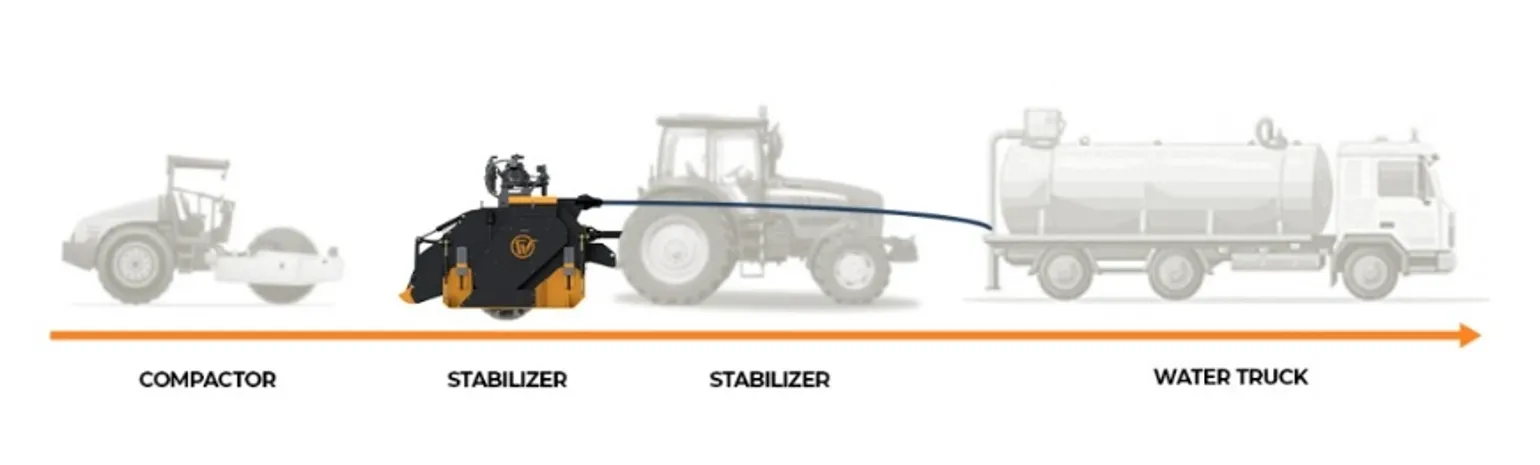
THOR ST mixes the most common soil stabilization materials — cement and lime — in a single pass
Full Material Comparison
| Material | Typical UCS | Best Soil Type | Relative Cost | Availability India |
|---|---|---|---|---|
| Portland Cement (OPC) | 1.5–5.0 MPa | Low-medium PI, granular | Medium | Excellent — nationwide |
| Quicklime (CaO) | 0.3–1.5 MPa | High PI clay, BCS | Medium-high | Good — near limestone belts |
| Fly Ash (Class F) + Lime | 0.5–1.5 MPa combined | With lime or cement activator | Low near thermal plants | Good — near coal power stations |
| GGBS + Lime or Cement | 1.0–2.5 MPa combined | Sulphate soils, coastal | Low-medium | Limited — near steel plants only |
| Foamed Bitumen | 0.5–1.5 MPa | Granular, PI < 12 | Medium | Requires specialist plant |
The Standard Indian Approach — Lime First, Then Cement
For most Indian road subgrade projects on Black Cotton Soil, the answer to “which material?” is both lime and cement — in sequence. Quicklime is applied first to reduce PI below 20 and make the soil receptive to cement treatment. After 24–72 hours for cation exchange, Portland cement is applied at the design content and mixed to full treatment depth by the THOR ST soil stabilizer machine. Both materials are applied using the DCW 2.2 binder spreader at ±2% accuracy — ensuring neither material is under or over-applied.
This two-stage approach is the IRC:SP:89 specified method for Black Cotton Soil and achieves 25–50 year design service life — the only method that permanently overcomes the expansive clay behaviour that causes annual road failure across the Deccan Plateau.
Portland cement and quicklime are not competing materials for soil stabilization in India — on Black Cotton Soil, they are complementary. Lime prepares the soil; cement provides the structural strength. Together, they produce a stabilized subgrade that lasts 20–50 years under Indian monsoon conditions.
Material Selection for Specific Indian Project Types
The ‘most common’ material varies by project type and location. The following guide maps common Indian project types to the appropriate stabilization material:
| Project Type | Typical Soil | Recommended Material(s) | Target UCS |
|---|---|---|---|
| PMGSY rural roads — Deccan Plateau | Black Cotton Soil, PI 35–55 | Lime (4–6%) + OPC (4–6%) | ≥ 1.5 MPa soaked |
| National highway subgrade — peninsular India | BCS or medium clay | Lime + OPC or PPC | ≥ 2.0 MPa soaked |
| Full depth reclamation — granular terrain | Existing gravel + subgrade | OPC (3–5%) or foamed bitumen | ≥ 1.5 MPa soaked |
| Industrial hardstand — interior Maharashtra | Schwarzerde | Lime + OPC (high content) | ≥ 3.0 MPa soaked |
| Coastal highway — Kerala/Tamil Nadu coast | Sandy silt, marine clay | PSC or SRC (sulphate exposure) | ≥ 1.5 MPa soaked |
| Airport apron — major city | Variable subgrade | OPC high content + fly ash | ≥ 4.0 MPa soaked |
Where to Source Stabilization Materials in India
Material sourcing strategy is as important as material selection. The delivered cost of lime or cement is the largest single project cost — sourcing from the nearest available supply reduces project cost and carbon footprint.
- OPC/PPC: Available from all major cement manufacturers (UltraTech, ACC, Ambuja, Shree, India Cements) across the country. No project in India is more than 150 km from a cement depot. No sourcing challenge.
- Quicklime: Concentrated production in Rajasthan (Jodhpur district), Maharashtra (Yavatmal, Chandrapur), Karnataka (Gulbarga), and MP (Satna, Katni). Projects in Vidarbha, Marathwada, and Telangana are within economic transport distance of multiple sources.
- Fly ash (Class F): Available near India’s 200+ coal thermal power stations. Largest volumes near Chhattisgarh, MP, Maharashtra, and UP power clusters. Power stations often provide fly ash free of charge or at minimal cost to reduce landfill obligation — contact the nearest thermal station directly.
- GGBS: Available near SAIL, Tata Steel, JSW, and RINL steel plants. Jamshedpur, Bhilai, Rourkela, Visakhapatnam, and Bellary are the primary production centres. Limited outside these regions.
Featured Equipment
THOR ST + DCW 2.2 Stabilization System
Cement · Lime · Fly Ash · GGBS — all binder types, one equipment package · India Watanabe
Key Takeaways
- Portland cement is the most commonly used soil stabilization material globally — achieves 1.5–5.0 MPa UCS, available nationwide, 7-day strength gain
- Quicklime is essential for Black Cotton Soil in India — permanently reduces PI from 40–60 to below 20 through cation exchange, making cement effective
- Fly ash reduces binder cost 25–40% when used in combination with lime or cement — available near India’s 220 million tonne/year coal power output
- GGBS provides better sulphate resistance than OPC — specified for coastal and industrial sites, limited to steel plant vicinities
- The standard IRC:SP:89 approach for Black Cotton Soil is lime first (PI reduction) then cement (structural strength) — both materials essential
- The DCW 2.2 binder spreader applies any combination of these materials at ±2% accuracy — preventing over and under-dosing