Soil Stabilization Guide
What Are the Different Types of Soil Stabilization?
Soil stabilization encompasses any technique that improves the engineering properties of soil — increasing bearing capacity, reducing plasticity, controlling swell, or improving durability. There are four broad categories: mechanical, chemical, biological, and thermal stabilization. For road construction and subgrade improvement at the scale of Indian highway programmes, chemical in-situ stabilization using cement and lime is the dominant and IRC-recommended method.
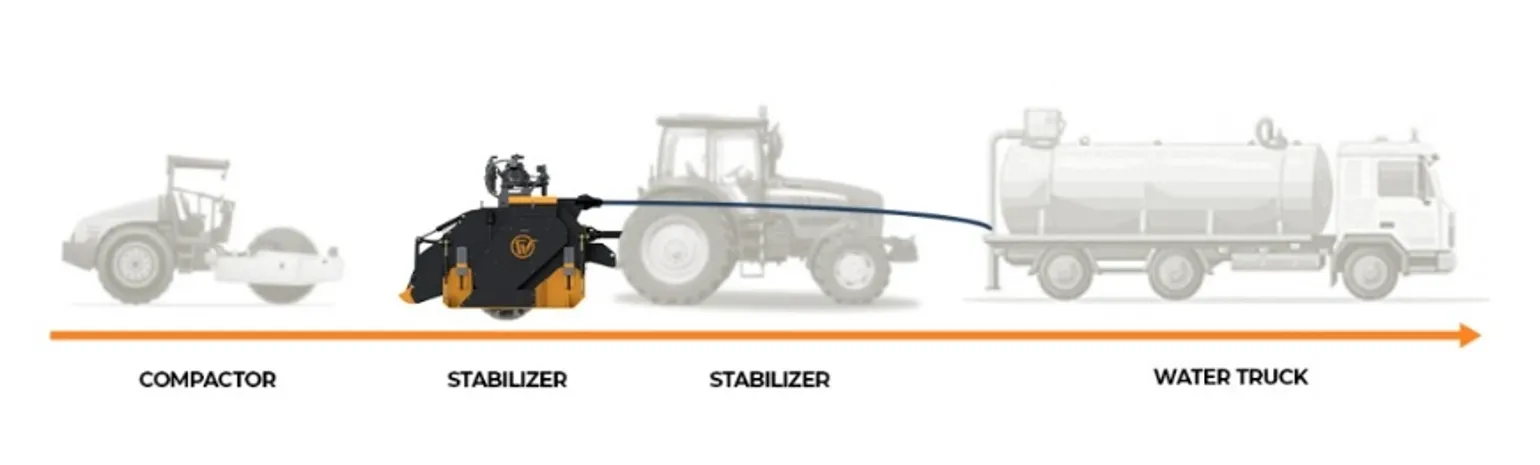
Chemical in-situ stabilization — the most effective type for Indian road subgrade
Type 1 — Mechanical Stabilization
Mechanical stabilization improves soil properties by physical means — compaction, particle size adjustment, or blending with better-graded material. No chemical binders are added. It is the simplest and cheapest form of stabilization, and the one most commonly misapplied — particularly on Black Cotton Soil in India, where compaction without chemical treatment delivers only a temporary improvement that fails at the first monsoon.
Compaction
Compaction applies energy to the soil — static, vibratory, or impact — to increase dry density and reduce air voids. Higher density means higher strength and lower permeability in the short term. However, compacted clay retains its expansive mineralogy — it will still swell when wetted and shrink when dried, and it will still lose most of its bearing capacity when saturated. Compaction alone does not solve the Black Cotton Soil problem.
Granular Soil Blending
Blending coarse aggregate, sand, or gravel into clay-rich soil reduces the clay fraction and improves the grading of the mix. This reduces plasticity and improves drainage. It is used when suitable blending material is locally available at low cost. On most Indian road projects, hauling aggregate to the site for blending is more expensive than chemical stabilization using lime and cement.
Geosynthetic Reinforcement
Geogrid and geotextile layers are placed horizontally in the soil to distribute load, prevent mixing of dissimilar materials, and provide tensile reinforcement. Geogrids improve the load-spreading capability of thin granular layers over soft subgrades. They are used in combination with compaction, not as a replacement for chemical stabilization on expansive soils.
Critical Limitation
Mechanical stabilization does not change the mineralogy of the soil. Compacted Black Cotton Soil with PI of 40 loses most of its bearing capacity when saturated — this is why Indian roads built on BCS fail every monsoon despite good compaction practices. No amount of compaction overcomes inherent clay plasticity.
Selecting the Right Stabilization Type for Indian Soil Conditions
India’s road network crosses six distinct soil macro-zones, each with characteristic stabilization requirements. Understanding which stabilization type is appropriate for each zone is fundamental to correct specification.
| Soil Zone | Predominant Soil | Recommended Stabilization Type | Primary Binder |
|---|---|---|---|
| Deccan Plateau (Maharashtra, Karnataka, Telangana, AP) | Black Cotton Soil (Vertisol) | Chemical — two-stage | Lime + Cement (OPC/PPC) |
| Indo-Gangetic Plain (UP, Bihar, Punjab) | Alluvial silt and clay | Chemical — single stage | Cement (OPC) |
| Rajasthan Desert | Aeolian sand, laterite | Chemical — single stage | Cement (OPC) or lime-fly ash |
| Western Ghats and coastal | Laterite, marine clay | Chemical — single stage | Cement (PSC or SRC) |
| Northeast India | Soft alluvial, organic | Mechanical + chemical | Lime modification + cement |
| Himalayan Foothills | Highly variable — glacial, colluvial | Site-specific assessment | Depends on test results |
In-Situ vs Ex-Situ Stabilization
In-Situ Stabilization (Surface Mixing)
In-situ stabilization — the method used by the THOR ST soil stabilizer machine — treats the soil in-place. The machine travels over the surface, milling the soil to the design depth, mixing the binder, and leaving a ready-to-compact material. No excavation, no stockpiling, no reimportation. This is the most cost-effective method for road subgrade treatment on projects where the existing soil can be modified to meet specification with chemical binders.
Ex-Situ Stabilization (Plant Mixing)
Ex-situ stabilization excavates the soil, transports it to a static mixing plant, mixes the binder under controlled conditions, and then places and compacts the stabilized material. This method achieves better mixing uniformity than in-situ surface mixing but at significantly higher cost — excavation, transport, mixing plant, and re-placement all add to the unit cost. Ex-situ mixing is specified where in-situ working is impractical (very wet sites, confined urban areas) or where very precise binder uniformity is required (high-strength applications).
Type 2 — Chemical Stabilization
Chemical stabilization uses binders that react with soil minerals to form permanent cementitious bonds, permanently reduce plasticity, or modify soil structure. This is the primary method for road subgrade improvement in India and the method specified by IRC:SP:89. It is the only type of stabilization that achieves both permanent PI reduction and structural UCS gain on Black Cotton Soil. See the full equipment description on our soil stabilizer machine page.
Portland Cement (OPC/PPC/PSC/SRC)
Portland cement is the most widely used chemical stabilizer globally. It forms calcium silicate hydrate (CSH) and calcium aluminate hydrate (CAH) crystals that permanently bond soil particles together, achieving soaked UCS of 1.5–5.0 MPa at 5–9% content by soil mass. Seven-day strength gain aligns with IRC:SP:89’s 7-day UCS acceptance criteria. OPC is the default choice when SO₃ < 0.5% and construction temperature is below 35°C; PPC is preferred in hot weather; PSC and SRC are specified for sulphate-bearing soils.
Quicklime (CaO)
Quicklime is the essential first-stage binder for Black Cotton Soil with PI above 25. It permanently reduces PI through cation exchange — calcium ions replace sodium and hydrogen ions on the clay mineral surface, eliminating the soil’s expansive behaviour. Lime alone achieves 0.3–1.5 MPa UCS — sufficient for soil modification but not for IRC:SP:89 structural stabilization. It is always followed by cement as the second stage on BCS.
Fly Ash, GGBS, and Foamed Bitumen
Fly ash (Class F) is a pozzolan used at 10–25% in combination with lime or cement, reducing binder cost by 25–40% while meeting IRC:SP:89 UCS requirements. India produces over 200 million tonnes of fly ash annually — making it the most cost-effective supplementary binder for stabilization projects near thermal power stations. GGBS provides better sulphate resistance than cement and is used in coastal and industrial applications. Foamed bitumen is used for full depth reclamation of failed asphalt roads in granular-rich terrain.
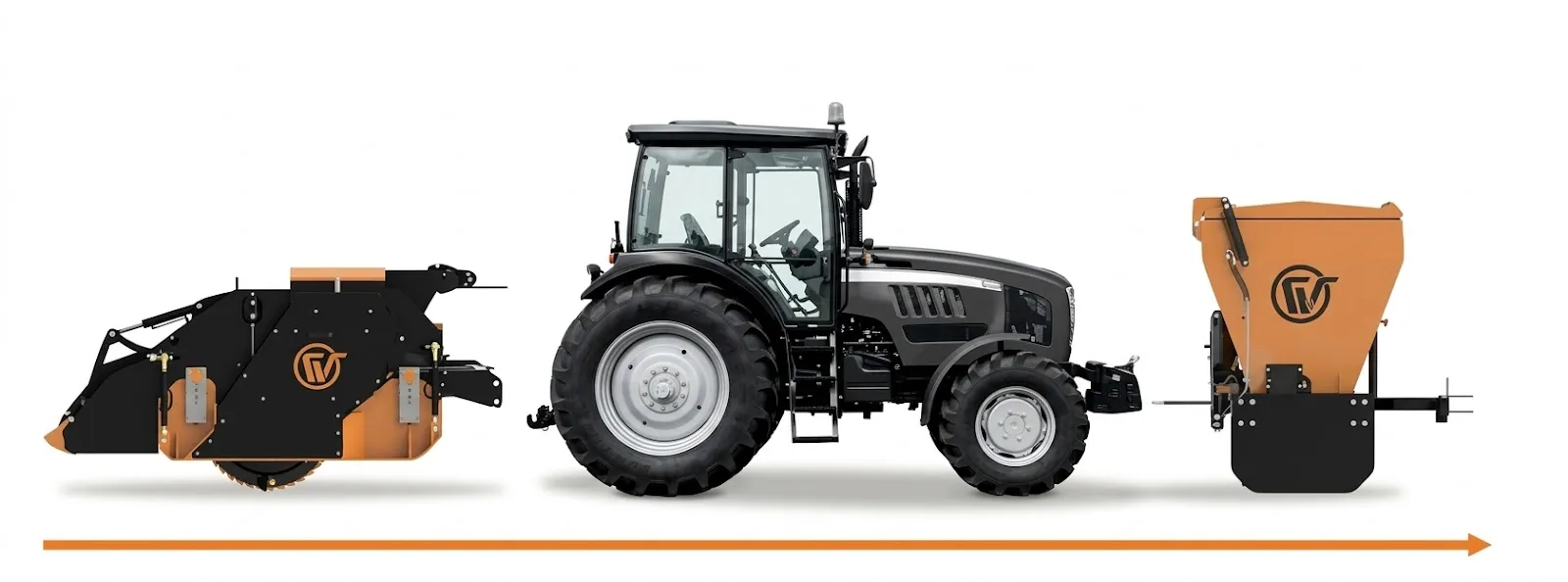
DCW 2.2 binder spreader — accurate application of chemical stabilization materials
IRC:SP:89 compliance: chemical in-situ stabilization achieving soaked UCS ≥ 1.5 MPa is counted as a structural pavement layer in IRC:37 thickness design — directly reducing the granular base and asphalt thickness required above and saving significant project cost.
Type 3 — Biological Stabilization
Biological stabilization uses living organisms or organic processes to improve soil properties. Three main approaches are used in niche applications:
- MICP (Microbially Induced Calcite Precipitation): Bacteria produce calcite that cements soil particles together. Effective at laboratory scale but difficult to control in field conditions — mainly a research-stage technique for road applications.
- Biopolymers: Xanthan gum, guar gum, and similar polymers coat soil particles and reduce permeability. Used in dust control and erosion prevention, but too expensive for large-scale road subgrade treatment.
- Vegetation: Deep-rooted plants stabilize slopes through root reinforcement and improved drainage. Effective for embankment slope protection but cannot be applied to road subgrade.
Biological stabilization is not suitable for high-traffic road construction at the scales required for Indian road programmes. Strength gains are modest (typically 0.1–0.5 MPa), costs are high, and quality control is complex. These methods are primarily used in erosion control, slope stabilization, and specialty geotechnical applications.
Type 4 — Thermal Stabilization
Thermal stabilization changes soil properties by heating. The most common form is soil calcination — heating clay soils to 600–900°C in a kiln, permanently destroying the clay mineral structure and producing a material that is pozzolanically active when combined with lime. This processed material can then be added back to soil as a stabilizing agent. However, thermal stabilization requires significant energy input (a kiln) and is not practical for in-situ road construction. It is used in material processing plants, not as a field technique on road projects.
Comparison — Which Type to Use?
| Method | Suitable For | Initial Cost | Service Life | Permanence |
|---|---|---|---|---|
| Mechanical (compaction) | Granular soils, temporary works | Laag | 5–15 yr | No — fails when saturated |
| Chemical (cement/lime) | All soil types, especially clay | Medium | 20–50 yr | Yes — permanent chemistry |
| Biological | Slopes, erosion control, dust | Hoog | Variable | Limited — biodegrades over time |
| Thermal | Material processing only | Very high | N/A (field) | N/A — plant-based only |
The Standard Approach for Indian Road Construction
For road subgrade stabilization in India — particularly on the 60 million hectares of Black Cotton Soil across the Deccan Plateau — chemical in-situ stabilization using quicklime followed by Portland cement is the dominant method. It is specified by IRC:SP:89, achieves IRC:37 pavement design credit, and is the only method that permanently overcomes the expansive clay behaviour that causes annual road failure. The equipment used is a tractor-mounted soil stabilizer machine paired with a calibrated binder spreader — completing subgrade treatment in a single machine pass.
Choosing Between Stabilization Types in Practice
In real projects, the choice between stabilization types is not always straightforward. Multiple types may be applicable, and the decision involves balancing technical requirements, material availability, equipment access, weather constraints, and budget. The following decision framework applies to most Indian road subgrade projects:
- Identify the soil’s primary problem: Is it low bearing capacity? High plasticity? Excessive moisture? Each problem points to a different solution. Low bearing on granular soil → compaction + cement. High plasticity Black Cotton Soil → lime + cement. Wet, trafficable clay → lime drying followed by cement.
- Test for sulphates and organic content: These two factors eliminate certain binder options before anything else. SO₃ > 0.5% eliminates OPC. Organic content > 5% may eliminate chemical stabilization entirely.
- Check material availability: Lime from a kiln 50 km away is much cheaper than lime from 400 km. Fly ash from an adjacent thermal plant may be nearly free. GGBS is only viable near steel plants.
- Check equipment availability: Foamed bitumen requires specialist plant. Lime and cement stabilization requires a tractor-mounted stabilizer machine — available from specialist contractors or purchased directly.
- Confirm design life requirement: Temporary access road (5 years) → compaction with lime modification. National highway subbase (30 years) → full lime + cement stabilization to IRC:SP:89.
The Role of Laboratory Mix Design in Selecting Stabilization Type
Laboratory mix design is the critical bridge between selecting a stabilization type and specifying a stabilization programme. Mix design testing on the actual project soil confirms: which binder works, at what content, and what UCS is achievable. It prevents both over-specification (specifying cement where lime modification alone suffices) and under-specification (specifying lime only on soil that needs cement for structural strength).
The recommended testing programme for any stabilization project follows IS:2720 for soil classification and IRC:SP:89 for mix design guidance. Contact India Watanabe for technical guidance on mix design for your specific project at soil-stabilisor.com.
Featured Equipment
THOR ST Soil Stabilizer Machine
Chemical in-situ stabilization · IRC:SP:89 compliant · All binder types · India Watanabe
Key Takeaways
- Four types of soil stabilization: mechanical, chemical, biological, and thermal — chemical is dominant for road construction
- Mechanical compaction cannot overcome inherent clay plasticity — Black Cotton Soil fails every monsoon regardless of compaction effort
- Chemical stabilization (cement + lime) achieves 20–50 year service life and permanent PI reduction — the only method that solves the BCS problem
- Lime + cement two-stage treatment is the IRC:SP:89 specified method for Black Cotton Soil across the Deccan Plateau
- Fly ash reduces chemical stabilization cost by 25–40% when used in combination with lime or cement
- Biological and thermal methods are not suitable for large-scale road subgrade work in India