Soil Stabilization Guide
How Much Does It Cost to Stabilize Soil with Lime?
Lime soil stabilization in India typically costs ₹100–241 per m² for the complete stabilization work including lime, second-stage cement (where required), plant hire, labour, and quality control. When compared with the conventional alternative — excavating weak Black Cotton Soil subgrade and replacing it with granular sub-base — lime stabilization consistently delivers a 25–45% reduction in initial construction cost and a 60–80% reduction in life-cycle cost over a 20-year horizon.
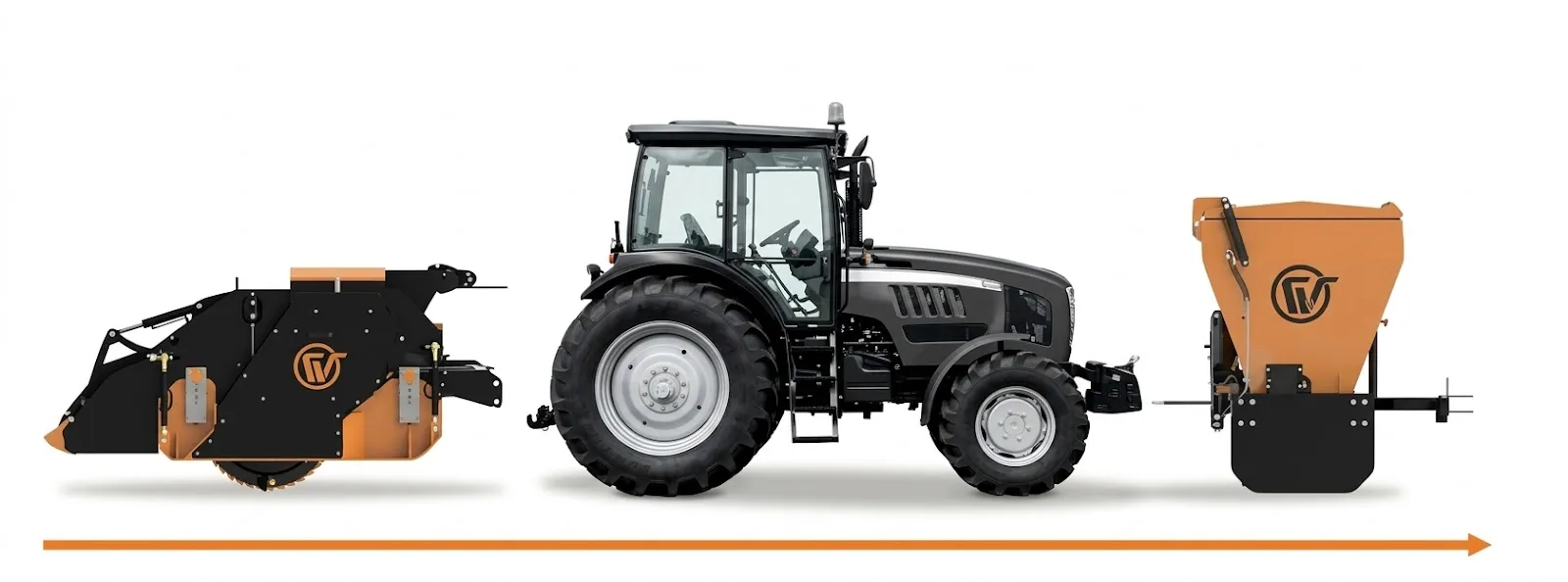
DCW 2.2 binder spreader applying quicklime — accurate lime application reduces waste and cost
Price Note
Prices in this article reflect typical Indian market conditions as of 2025–2026. Quicklime prices vary significantly by region — Maharashtra and Karnataka (near major lime kilns) are 25–40% cheaper than remote Northeast or Himalayan locations where lime must be transported long distances. Always obtain current local quotes for project budgeting.
Mobilisation and Demobilisation Costs
For small projects (below 5,000 m²), mobilisation and demobilisation of the stabilizer machine, binder spreader, and compaction equipment adds a fixed cost component that can significantly increase the effective unit rate. Typical mobilisation costs for a complete stabilization equipment train (stabilizer, spreader, 2 rollers, water tanker) within 200 km: ₹50,000–100,000 per mobilisation. This translates to ₹10–20 per m² on a 5,000 m² project but only ₹1–2 per m² on a 50,000 m² project.
For small projects, it is often cost-effective to combine with adjacent projects to share mobilisation costs, or to use subcontractors who already have equipment in the region.
Cost Factors That Increase Unit Rate
- Remote site location: Every 100 km increase in quicklime transport distance adds approximately ₹10–15/m² to material cost. Projects in remote Chhattisgarh, J&K, or Northeast India face significantly higher lime costs than projects in Maharashtra or Rajasthan
- Multiple passes: Two-stage lime + cement treatment requires two equipment passes (lime pass day 1, cement pass day 2–3), approximately doubling plant hire cost vs single-stage cement treatment
- High binder content: Hard, high-plasticity Black Cotton Soil may require 6–7% lime in the first stage and 6–8% OPC in the second stage — significantly above the minimum required for lower-PI soils
- Thin treatment areas: Small, isolated treatment sections have higher mobilisation cost per m² than continuous road sections
- Urban construction: Night work, traffic management, site access restrictions, and dust control in urban areas can add 20–40% to rural road unit rates
Procurement Options — Owned Equipment vs Subcontracting
For contractors with significant annual stabilization volume (above 200,000 m²/year), owned equipment is typically more cost-effective than subcontracting. The THOR ST soil stabilizer machine and DCW 2.2 binder spreader, with proper maintenance, have service lives exceeding 10 years at moderate utilisation — making the capital investment cost approximately ₹3–6/m² when amortised over the machine’s working life. Subcontracted rates typically include 30–50% margin over direct plant cost, making owned equipment significantly cheaper for high-volume operators.
Equipment Investment Threshold
If your annual stabilization volume exceeds 150,000–200,000 m² per year, owned equipment is typically more cost-effective than subcontracting at current Indian market rates. Below this threshold, subcontracting is preferable to avoid idle equipment costs during slow periods.
How to Reduce Lime Stabilization Cost Without Reducing Quality
Several practical measures can reduce the unit cost of lime stabilization without compromising specification compliance:
- Source lime locally: Every 100 km reduction in lime transport distance saves ₹10–15/m². Identify the nearest kiln before finalising project budget. For large projects (> 50,000 m²), approach kilns directly for supply contracts at below-retail prices
- Use fly ash as a partial replacement: Near thermal power stations, Class F fly ash at 15–20% of the lime dose can replace some of the lime content while maintaining target UCS, reducing binder cost by 15–25%
- Combine adjacent projects: Share mobilisation costs across multiple small projects in the same district or corridor. Mobilisation cost per m² drops from ₹20/m² on a 5,000 m² project to ₹2/m² on a 50,000 m² combined project
- Optimise treatment depth: IRC:SP:89 allows 150 mm treatment depth for lightly trafficked rural roads. Increasing to 200 mm adds approximately ₹40–60/m² in material cost — only justified for heavier traffic or higher subgrade stress conditions
- Conduct laboratory mix design to minimise binder content: Generic 5% lime specifications often exceed what is actually required for the target UCS. Laboratory mix design may show that 3.5–4.0% lime achieves the same UCS — a saving of 0.5–1.5 kg/m² of lime material
Monitoring Cost After Construction
Post-construction monitoring is often budgeted at zero but is essential for protecting the value of the stabilization investment. Recommended monitoring programme for PMGSY rural roads on stabilized BCS:
| Monitoring Activity | Frequency | Cost | Purpose |
|---|---|---|---|
| Visual inspection — crack mapping | Annual | ₹5,000–15,000/km | Identify surface cracking before water penetration |
| Crack sealing | When cracks > 2 mm width | ₹20–40/m of crack | Prevent water access to stabilized layer |
| Deflectograph or Benkelman beam | Every 5 years | ₹30,000–60,000/km | Structural condition assessment |
| Core sampling and UCS check | If deflection increases | ₹2,000–5,000/core | Confirm stabilized layer integrity |
Component 1 — Quicklime Material Cost
Quicklime (CaO) is typically the largest single cost in a lime stabilization project. Prices vary by location and volume:
| Supply Condition | Price per Tonne |
|---|---|
| Kiln gate price (Maharashtra, Karnataka, Rajasthan) | ₹5,000–7,000 |
| Delivered to site within 100 km of source | ₹6,500–9,000 |
| Delivered to site 100–300 km from source | ₹8,000–12,000 |
| Delivered to remote site 300–500 km from source | ₹10,000–14,000 |
Lime material quantity per m² of treatment area (150 mm depth, 4.5% lime, dry soil density 1,600 kg/m³):
Lime quantity = 0.15 m × 1,600 kg/m³ × 4.5% = 10.8 kg/m²
At ₹7,500/tonne delivered: ₹81 per m² for lime material alone. At ₹12,000/tonne (remote site): ₹130 per m².
Component 2 — Second-Stage Cement
For Black Cotton Soil requiring lime + cement two-stage treatment (the standard IRC:SP:89 approach for PI > 25 soil), Portland cement is applied in a second pass after the lime pre-treatment period (24–72 hours).
Cement quantity at 5% OPC (150 mm depth, same soil density):
Cement quantity = 0.15 m × 1,600 kg/m³ × 5% = 12 kg/m²
At ₹350–400 per 50 kg bag: ₹84–96 per m² for cement material.
Component 3 — Plant and Equipment Hire
A complete lime + cement stabilization operation requires a soil stabilizer machine (THOR ST), a binder spreader (DCW 2.2), compaction equipment, and a water tanker. For projects without owned equipment, hire rates in India are approximately:
| Equipment | Daily Hire Rate |
|---|---|
| Soil stabilizer machine (THOR ST equivalent) | ₹8,000–15,000/day |
| Binder spreader (DCW 2.2 equivalent) | ₹3,000–5,000/day |
| Pneumatic roller (compaction) | ₹5,000–8,000/day |
| Smooth drum vibratory roller | ₹5,000–8,000/day |
| Water tanker (10,000 L) | ₹3,000–5,000/day |
| Tractor (if not included with stabilizer) | ₹5,000–8,000/day |
A stabilizer system covers 2,000–3,500 m²/day on rural road projects (two passes — lime first, cement second). At ₹35,000–45,000 total plant cost per day and 2,500 m² coverage: ₹14–18 per m² for plant hire.
Component 4 — Labour and Quality Control
Labour requirements are low relative to conventional earthworks — soil stabilization is highly mechanised. Typical labour cost including operators, labourers, grade checkers, and supervisory staff: ₹8–15 per m².
Quality control and laboratory testing (pre-construction mix design, field moisture checks, 7-day UCS cores) amortised across a typical project area: ₹3–8 per m².
Total Cost Summary
| Cost Component | ₹ per m² (BCS, 150 mm, 4.5% lime + 5% OPC) |
|---|---|
| Quicklime material (delivered within 100 km) | ₹75–100 |
| Second-stage Portland cement | ₹84–96 |
| Plant hire (both passes) | ₹14–18 |
| Labour | ₹8–15 |
| Quality control and testing | ₹3–8 |
| Total — lime-only modification (PI reduction only) | ₹100–141 |
| Total — lime + cement stabilization (structural) | ₹184–237 |
Comparative Cost — Lime Stabilization vs Conventional Alternatives
Lime + cement stabilization must be compared not just on initial cost but on life-cycle cost — the total cost of the road subgrade over its design period including initial construction, maintenance, and rehabilitation.
| Method | Initial Cost (₹/m²) | Effective Life | 20-Year Life Cycle Cost |
|---|---|---|---|
| Lime + Cement stabilization | ₹184–237 | 20–40 years | ₹200–260 |
| Excavate and replace with GSB (300 mm) | ₹320–480 | 10–15 years | ₹500–700 (includes one rebuild) |
| Annual gravel blinding (no treatment) | ₹30–60/year | Ongoing | ₹600–1,200 over 20 years |
| Cement stabilization only (no lime pre-treatment on BCS) | Not recommended — will fail | < 3 years | Higher than GSB replacement |
Lime + cement stabilization is cheaper in initial cost than GSB replacement on Black Cotton Soil — and vastly cheaper over a 20-year life cycle. The typical 20-year saving is ₹250–440 per m², equivalent to ₹2.5–4.4 crore per kilometre of single-lane rural road. This explains why IRC:SP:89 chemical stabilization is the preferred method for PMGSY rural road construction on BCS terrain.
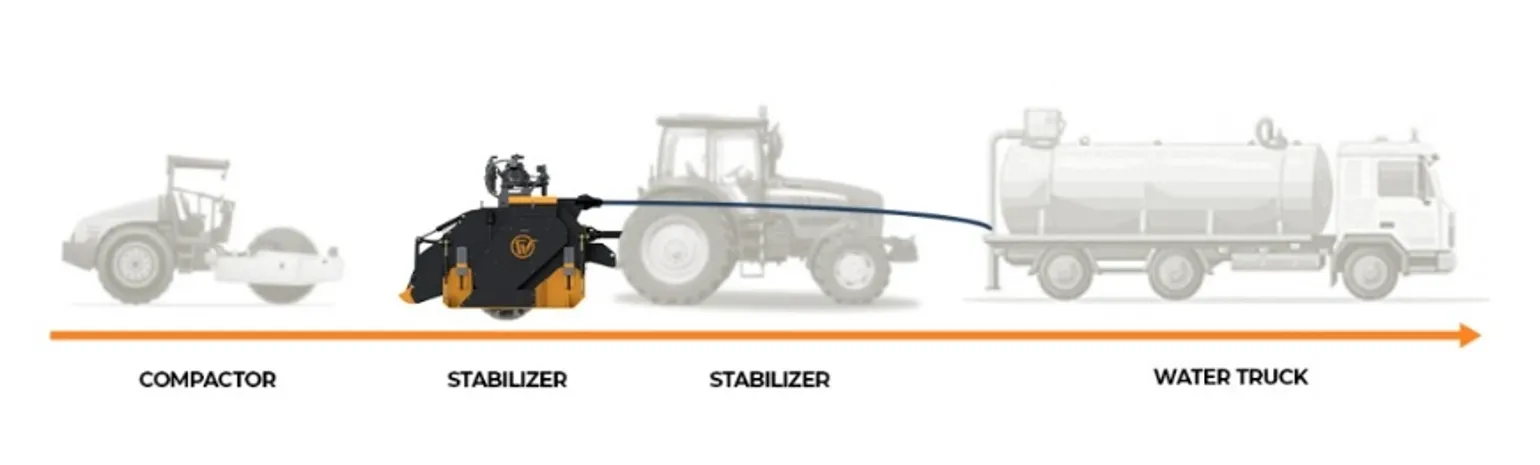
THOR ST stabilization is 25–45% cheaper than GSB replacement in initial cost on Black Cotton Soil
Where to Source Quicklime in India
Quicklime production is concentrated near limestone deposits. For projects in BCS-dominant regions, the nearest source regions are:
- Maharashtra: Yavatmal, Chandrapur, Nanded, Akola districts — well-positioned for Vidarbha BCS
- Rajasthan: Jodhpur, Udaipur, Chittorgarh, Jaipur — India’s largest production volumes
- Karnataka: Gulbarga (Kalaburagi), Bidar, Raichur — proximity to Telangana and AP BCS
- Madhya Pradesh: Satna, Rewa, Katni — central India supply
- Telangana/AP: Nalgonda, Kurnool districts — local supply for Deccan Plateau projects
Factors That Affect Lime Stabilization Cost
The ₹100–241 per m² range covers a wide spread of project conditions. Understanding what drives costs up or down allows accurate budget preparation before tendering.
| Cost Driver | Lower Cost Condition | Higher Cost Condition |
|---|---|---|
| Lime source distance | < 100 km from kiln | > 300 km from kiln |
| Treatment depth | 150 mm (minimum for BCS) | 250–300 mm (deep treatment) |
| Lime content | 4% (light modification) | 6–7% (heavy BCS or wet soil) |
| Second-stage cement | Not required (lime modification only) | Required (structural stabilization) |
| Project scale | > 50,000 m² (equipment mobilisation spread) | < 5,000 m² (high mobilisation cost per m²) |
| Season | Dry season (October–February in Deccan) | Pre-monsoon (March–May, hot weather, PPC needed) |
How to Reduce Lime Stabilization Cost Without Reducing Quality
- Source lime locally: Every 100 km reduction in lime transport distance saves approximately ₹4–6/m². Identify the nearest lime kiln before finalising the project budget
- Use fly ash to replace part of the cement: 15% fly ash replacing 15% OPC in the second stage reduces cement cost by ₹12–15/m² — fly ash near thermal plants may be free or near-free
- Optimise treatment depth: IRC:SP:89 minimum is 150 mm for road subgrade. Design to the minimum depth that achieves structural requirements — every extra 25 mm adds approximately ₹25–35/m²
- Maximise project scale: Equipment mobilisation, laboratory setup, and contractor establishment costs are largely fixed. Projects above 50,000 m² achieve economies of scale of 15–25% over small projects
- Time construction for dry season: Dry season construction uses less lime to achieve OMC (soil is drier, requiring less lime drying effect) and avoids hot weather PPC premium
Estimating Cost for Your Project
To prepare a project-specific cost estimate, contact India Watanabe with: your soil PI, SO₃ content (if tested), target treatment depth, project area in m², and nearest lime source location. We can provide indicative material quantities and arrange contractor contacts in your region. Start at soil-stabilisor.com/soil-stabilizer/ for equipment details.
Featured Equipment
DCW 2.2 Binder Spreader
Calibrated quicklime and cement application · ±2% accuracy · 2.2 m spread width
Key Takeaways
- Lime + cement stabilization costs ₹184–237 per m² total for 150 mm treatment on Black Cotton Soil
- 25–45% cheaper initial cost than GSB excavation and replacement — and 60–80% cheaper over a 20-year life cycle
- Typical 20-year saving of ₹2.5–4.4 crore per km of single-lane rural road vs conventional GSB replacement
- Quicklime material cost (₹75–130/m²) is the largest component — source locally from Maharashtra, Rajasthan, or Karnataka to minimise transport cost
- Plant hire (₹14–18/m²) is low relative to material costs — calibrated DCW 2.2 binder spreader prevents material waste from over-application
- Quality control cost (₹3–8/m²) is the smallest component with the highest return — mix design failures cost ₹300–600/m² to remediate