Soil Stabilization Guide
What Does a Soil Stabilizer Do?
A soil stabilizer is a tractor-mounted machine that mixes chemical binders — cement, lime, fly ash, or GGBS — uniformly into weak or unstable soil to a controlled depth, improving bearing capacity, reducing plasticity, and producing a hardened subgrade layer that resists moisture and traffic loading. In simple terms: it turns soft, unstable ground into a firm, engineered sub-base in a single machine pass.
THOR ST Soil Stabilizer — tractor-mounted in-situ stabilization on Black Cotton Soil
The Four Things a Soil Stabilizer Does
Understanding what a soil stabilizer does requires looking at four simultaneous actions that happen in a single machine pass. Each action is critical — miss one, and the stabilized layer will underperform its design specification.
1. Mills the Soil to the Design Depth
The machine’s rotor — fitted with carbide-tipped teeth — rotates at high speed and cuts into the ground to a pre-set depth, typically 100–350 mm. This breaks up compacted soil, clay lumps, existing road pavement, and any surface binder that has been applied, creating a uniform loose mix that is ready to receive and hold the binder. The cutting action is critical — soil that is not fully broken up will not mix uniformly, and patchy mixing means patchy strength.
2. Mixes Binder Uniformly into the Soil
As the rotor mills the soil, binder (cement or lime) that has been spread on the surface is incorporated into the full treatment depth. The mixing action is thorough — every part of the treatment zone receives an even distribution of binder. This uniformity is critical for achieving consistent strength across the entire project area. A poorly mixed zone that receives less than the design binder content will be weaker and may fail under traffic loading, even if the surrounding material is strong.
3. Controls Moisture During Mixing
Most soil stabilizer machines include a water injection system. This adds water to the mix during the stabilizing pass to bring the soil moisture content to the Optimum Moisture Content (OMC) — the moisture level at which the stabilized mix achieves maximum density and strength when compacted. Without controlled moisture addition, achieving consistent UCS is nearly impossible in dry conditions. The soil may look uniform after mixing, but if moisture is too low or too high, compaction will not achieve the required density and strength will be compromised.
4. Produces a Compactable, Chemically Active Mix
The output of a stabilizer pass is a loose, uniformly mixed material that can be immediately compacted. The chemical reactions between the binder and soil begin within minutes of mixing — so compaction must follow quickly to lock in the bonds before they form in an uncompacted state. This timing constraint — typically a 2-hour window for cement stabilization — is one of the most important operational constraints in soil stabilization and one of the most frequently violated on poorly managed projects.
Key Engineering Principle
The soil itself becomes the construction material. No excavation, no imported aggregate, no disposal — the stabilizer works with what is already there, reducing construction cost by 30–50% compared to full excavation and replacement on Black Cotton Soil road projects.
The THOR ST Soil Stabilizer Machine — Technical Overview
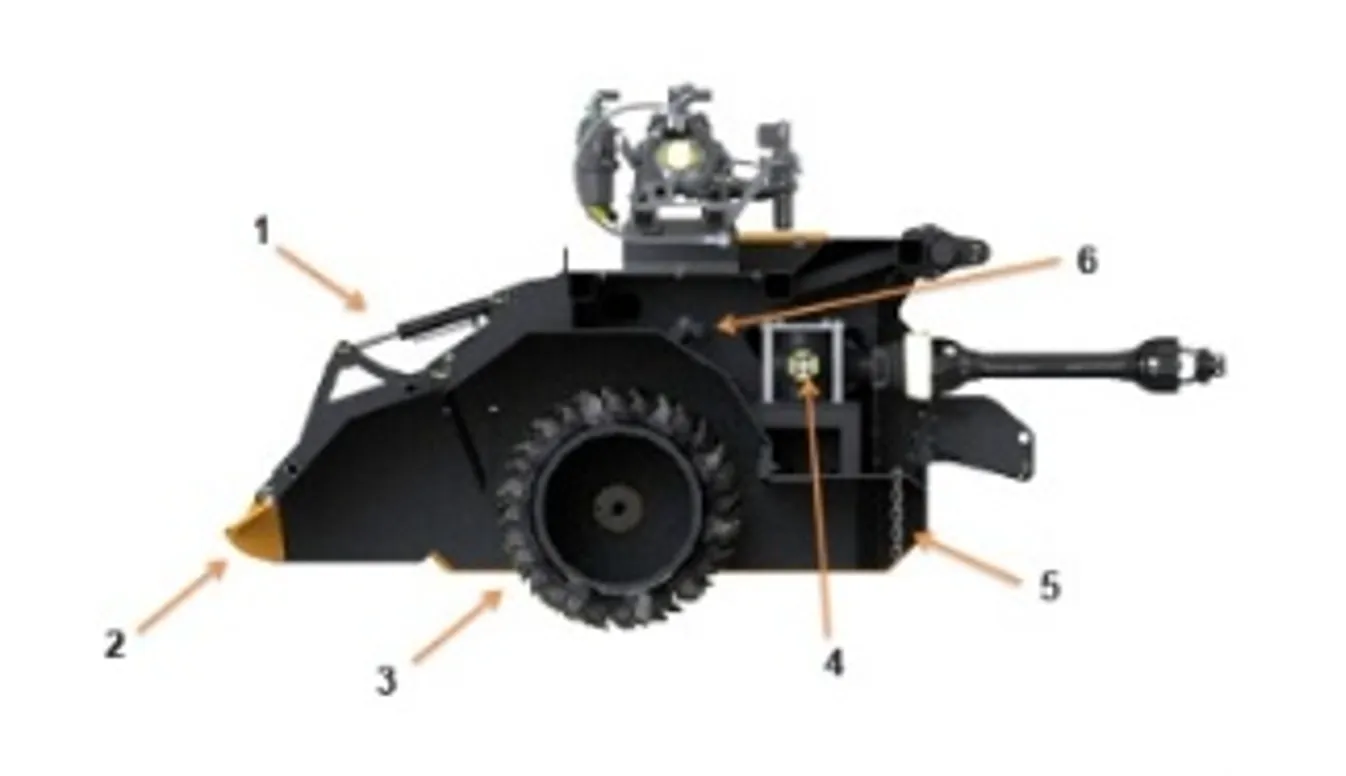
The Watanabe THOR ST is a tractor-mounted in-situ soil stabilizer designed specifically for road subgrade stabilization to IRC:SP:89 specification. The machine mounts on the rear three-point linkage of a Category 2 or 3 tractor and is driven by the tractor’s PTO shaft.
Rotor System
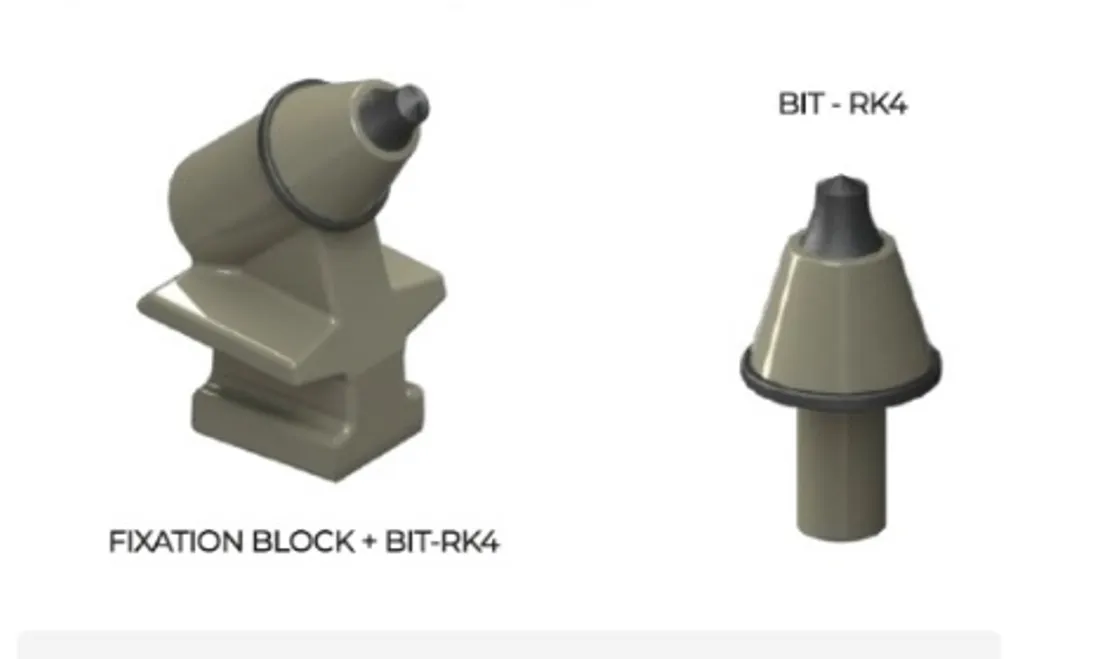
The THOR ST’s rotor is the RK4 — a high-inertia drum fitted with carbide-tipped cutting teeth arranged in a helical pattern. The helical arrangement ensures that soil cut on one side of the rotor is displaced towards the centre rather than thrown outwards, improving lateral binder distribution uniformity. Working depth is adjustable from 50 mm to 350 mm using the rear roller depth control.
Water Injection System
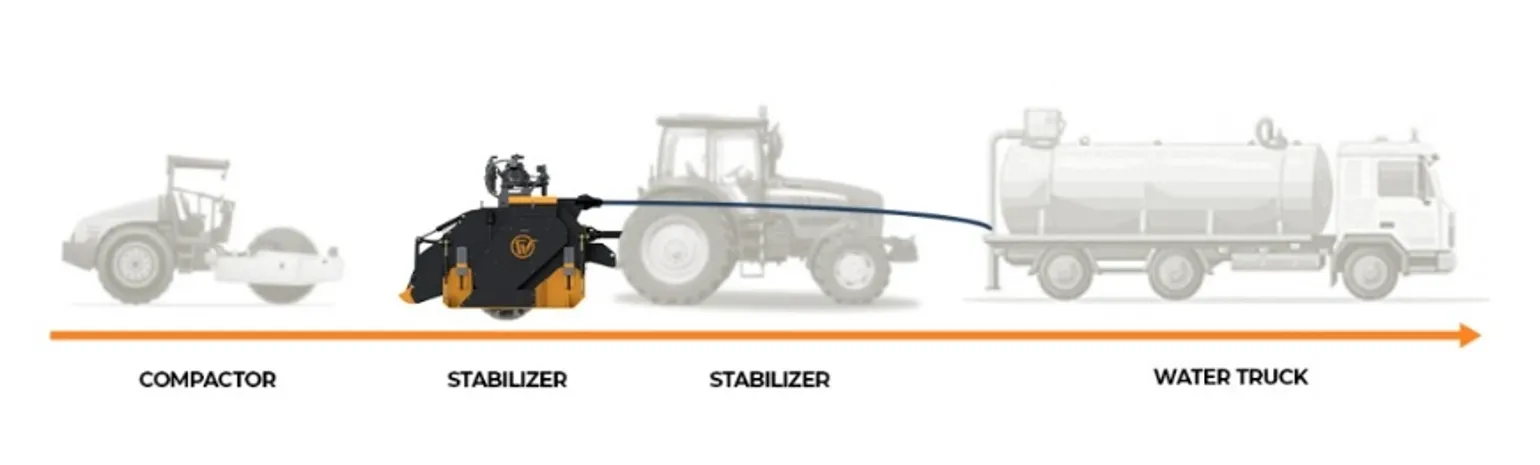
The integrated water injection system draws from a following water tanker via a flexible hose connection and distributes water through nozzles mounted inside the rotor chamber. Water flow rate is adjustable to bring any soil type to its target OMC during the mixing pass. The water injection system eliminates the need for a separate watering pass before or after mixing — saving one full machine pass on every project.
Working Parameters
| Parameter | Specification |
|---|---|
| Treatment depth | 50–350 mm (adjustable) |
| Working width | Up to 2.4 m |
| Working speed | 3–8 km/h |
| PTO speed | 540 or 1,000 rpm |
| Tractor requirement | Category 2/3, minimum 120 cv |
| Binders handled | Cement, lime, fly ash, GGBS, foamed bitumen |
Frequently Asked Questions
Can a soil stabilizer machine work on slopes?
Yes — the THOR ST is routinely used on embankment slopes and side slopes up to 1:3 gradient. Cross-slope working requires tractor stability assessment — consult the tractor manufacturer’s maximum side-slope rating. For slopes steeper than 1:2, specialist slope stabilization equipment may be required.
What tractor power is needed to run the THOR ST?
A minimum of 120 cv is required for the THOR ST in standard soil conditions. For dense, dry Black Cotton Soil or full depth reclamation of heavily trafficked road bases, 150–180 cv is recommended to maintain working speed and prevent stalling at depth. A higher-powered tractor does not consume more fuel at light loads — it simply provides the reserve power needed in difficult conditions without stalling.
What Happens Chemically When a Soil Stabilizer Works?
The soil stabilizer machine creates the physical conditions for chemical reactions — it mixes the binder uniformly and adds water. The chemistry then does the work over the following hours and days. Understanding the chemistry helps understand why stabilization succeeds or fails.
Cement Stabilization — CSH Crystal Formation
When cement mixes with soil and water, it undergoes hydration — forming calcium silicate hydrate (CSH) and calcium aluminate hydrate (CAH) crystals. These crystals grow through the pore spaces between soil particles, binding them together permanently. The process is identical to what happens inside a concrete mix, just with soil particles instead of crushed aggregate. The resulting matrix has strength of 1.5–5.0 MPa — sufficient for structural road subgrade. The reaction is irreversible and moisture-independent once cured: a cement-stabilized layer that has achieved its design UCS will not soften when saturated.
Lime Stabilization — Cation Exchange and Pozzolanic Reaction
Lime stabilization is a two-stage chemical process. First, quicklime reacts with water in the soil exothermically — releasing heat, drying wet clay, and making it workable for mixing. This reaction happens within minutes of mixing and is why lime is used to dry out excessively wet clay before mechanical operations. Second — and more importantly — calcium ions from the lime replace sodium and hydrogen ions on clay particle surfaces through cation exchange. This permanently reduces the soil’s plasticity index (PI). Black Cotton Soil with PI of 50–60 drops to below 20 after lime treatment. Over weeks and months, lime also reacts with silica and alumina in the clay (the pozzolanic reaction) to form CSH and CAH crystals — adding structural strength on top of the PI reduction.
RK4 rotor — carbide-tipped teeth mill soil and incorporate binder to 350 mm depth
Before vs After Stabilization — What Changes
The measurable improvements from correctly designed and executed soil stabilization are substantial. The table below shows typical values for Black Cotton Soil treated with lime + cement to IRC:SP:89 specification.
| Property | Before Stabilization | After Stabilization (IRC:SP:89) |
|---|---|---|
| Soaked CBR | 2–5% | 15–80% |
| Soaked UCS | 0.02–0.1 MPa | 1.5–5.0 MPa |
| Plasticity Index (BCS) | 35–60 | < 20 |
| Swell on saturation | 5–15% | < 1.5% |
| Bearing capacity when wet | Fails under traffic | Retains 70–90% of dry strength |
| Service life | Annual rehabilitation | 20–50 years |
Where Is a Soil Stabilizer Used?
The soil stabilizer machine is used wherever weak or unstable soil needs to be improved for structural performance — road construction accounts for the largest share of applications in India, but the machine is equally effective in agricultural, industrial, and environmental applications.
- Road subgrade treatment — National highways, rural roads (PMGSY), urban roads. Lime + cement two-stage treatment on Black Cotton Soil is the IRC:SP:89 standard approach
- Full depth reclamation — Recycling failed asphalt roads in-place. The stabilizer mills existing pavement and subgrade together, mixes cement or foamed bitumen, and creates a new stabilized base without excavation or material import
- Embankment stabilization — Strengthening fill slopes against seepage and mass movement. Lime stabilization improves shear strength and reduces seepage through embankment fill
- Industrial platforms — Warehouse floors, container yards, airport aprons. High cement content (8–12%) produces 3–5 MPa UCS suitable for heavy forklift and container loading
- Agricultural hardpan breaking — Fracturing compaction layers that block monsoon rainfall infiltration. Subsoil treatment reduces surface runoff by 40–70% and improves crop water availability
- Mine haul roads — Dust control and surface stabilization. Calcium chloride or lime treatment binds fine particles and prevents PM10 dust emissions from unpaved haul roads
THOR ST on road construction project — full depth treatment of Black Cotton Soil subgrade
How Is a Soil Stabilizer Different from a Rotavator?
A common question is the difference between a soil stabilizer and a rotavator. The two machines look superficially similar — both have a rotor that rotates and cuts into soil — but they are entirely different in purpose, construction, and output.
| Feature | Soil Stabilizer | Rotavator |
|---|---|---|
| Working depth | 100–350 mm | 100–250 mm |
| Primary purpose | Road subgrade strengthening | Agricultural seedbed preparation |
| Binder mixing | Yes — cement, lime, fly ash, GGBS | No — loosens soil only |
| Water injection | Yes — integrated system | No |
| Output | Structurally engineered layer | Loose, tillable seedbed |
| Standard | IRC:SP:89 (India) | Agricultural practice |
| Strength gain | 1.5–5.0 MPa soaked UCS | None — no binder |
The PSW-3200 rotavator is used before potato planting and other root crop cultivation. The THOR ST soil stabilizer is used for road subgrade improvement. Both machines are available from India Watanabe, and on potato-growing farms with rocky or compacted soils, both are typically used in the same operation — rock picking first, then rotavating, then planting.
A soil stabilizer machine does not just break up soil — it engineers the soil. The binder, the depth, the moisture, and the compaction are all controlled to produce a layer with specified strength and durability, validated by laboratory testing to IRC:SP:89 acceptance criteria.
Featured Equipment
THOR ST Soil Stabilizer Machine
350 mm depth · IRC:SP:89 compliant · Black Cotton Soil proven · India Watanabe
Key Takeaways
- A soil stabilizer mills soil to depth, distributes binder uniformly, controls moisture, and produces a layer ready to compact — in a single tractor pass
- Cement forms permanent CSH/CAH crystals; lime permanently reduces plasticity index through cation exchange — both reactions are irreversible
- Soaked UCS improves from 0.02–0.1 MPa to 1.5–5.0 MPa — meeting IRC:SP:89 structural stabilization requirements for road pavement design credit
- Service life of 20–50 years versus annual rehabilitation cost for untreated Black Cotton Soil subgrade
- 30–50% cheaper than full excavation and GSB replacement — and significantly cheaper over a 20-year life cycle
- Not the same as a rotavator — a soil stabilizer engineers a structural layer with chemical binders; a rotavator prepares a seedbed without binders