● Materials Guide
What Is Soil Stabilization with Cement?
Soil stabilization with cement is the process of mixing Portland cement into in-situ soil to permanently increase its strength, reduce its plasticity, and make it resistant to the effects of water and traffic loading. It is the most widely used chemical stabilization method in road construction worldwide, and for good reason: when correctly designed and executed, cement-stabilized soil delivers reliable, measurable, long-lasting results on a wide range of soil types.
What Is Cement Soil Stabilization?
Cement soil stabilization — also called soil-cement stabilization — involves adding a measured quantity of Portland cement to a soil, mixing it uniformly to the required depth, compacting the mixture to maximum dry density, and allowing it to cure into a bound, cementitious layer. The treated layer is no longer loose soil: it behaves structurally like a weak concrete, with measurable compressive strength and a rigid response to load.
Unlike lime stabilization — which works primarily on high-plasticity clays through ion exchange and slow pozzolanic reactions — cement stabilization works on a broader range of soil types including granular soils, silts, and low-to-moderate plasticity clays. It produces faster strength gain, achieves higher final strength, and is less dependent on the soil’s mineral composition.
According to road design standards including IRC:37 (India), AASHTO, and the UK’s Design Manual for Roads and Bridges, cement-stabilized subbase and subgrade layers can be included in the structural design of a pavement, allowing the thickness of the overlying asphalt or granular layers to be significantly reduced — producing cost savings that typically far exceed the cost of the cement itself.
Design Standard Reference
Under IRC:SP:89 (Guidelines for Soil and Granular Material Stabilization Using Cement, Lime and Fly Ash), the target unconfined compressive strength (UCS) for cement-stabilized subbase in Indian road construction is 1.5–3.0 MPa at 7 days — compared to near-zero UCS for the untreated weak soil beneath it.
The Chemistry: How Cement Strengthens Soil
The strength of cement-stabilized soil comes from a series of chemical reactions that begin the moment cement contacts water in the soil pores. Understanding these reactions explains why cement stabilization works — and what can go wrong when it is not correctly executed.
Stage 1 — Hydration (Minutes to Hours)
Portland cement is composed of calcium silicates (C₂S and C₃S), calcium aluminates (C₃A), and calcium aluminoferrite (C₄AF). When these compounds contact water, they hydrate rapidly, releasing calcium hydroxide (Ca(OH)₂) and forming calcium silicate hydrate (CSH) and calcium aluminate hydrate (CAH) gels. These gels are the primary source of strength in cement-treated materials. They precipitate as interlocking needle-like crystals that coat and bind soil particles together, filling void spaces and creating a rigid matrix between particles.
Stage 2 — Pozzolanic Reaction (Days to Weeks)
The calcium hydroxide released during hydration is not wasted — it reacts with any reactive silica and alumina present in the soil particles themselves in a secondary pozzolanic reaction. This reaction forms additional CSH and CAH at the cement-soil particle interface, further increasing the strength of the bond between the cement matrix and the soil. This secondary reaction continues for weeks and months after mixing, which is why the 28-day UCS of a cement-stabilized soil is significantly higher than its 7-day UCS.
Stage 3 — Long-Term Strength Development (Months to Years)
Cement hydration is never truly complete under normal conditions. The C₂S component in particular continues to hydrate slowly for years, contributing modest ongoing strength gain. In well-constructed cement-stabilized layers, the material continues to strengthen slowly throughout its service life — the opposite of the progressive weakening that occurs in untreated weak soils.
“
Cement-stabilized soil does not just get stronger over time — it continues to strengthen slowly for years, making it one of the most durable subgrade treatments available.
Which Soils Are Suitable for Cement Stabilization?
Cement stabilization is effective on a wide range of soil types, but performs differently depending on soil classification. The following table summarizes suitability and typical cement content by soil type:
| Soil Type | Suitability | Typical Cement Content | Примечания |
|---|---|---|---|
| Gravel / Coarse Sand | Отличный | 3–5% | High strength gain; low cement demand; ideal for road base recycling |
| Sandy Soil | Very Good | 5–9% | Good strength and durability; widely used for rural road subgrades |
| Silt | Хороший | 7–12% | Responds well; moisture control critical during mixing and compaction |
| Low-Plasticity Clay (PI < 20) | Хороший | 8–14% | Achieves good results; pre-mixing with lime may be needed to reduce PI first |
| High-Plasticity Clay (PI > 25) | Poor alone | N/A alone | Lime pre-treatment required to reduce PI below 20 before cement is effective |
| Organic Soil (OC > 2%) | Not suitable | — | Organic matter interferes with cement hydration; soil must be removed or treated differently |
The Cement Stabilization Process: Step by Step
Cement stabilization follows a precise sequence. Deviating from this sequence — in particular compacting late or leaving the mixed layer uncompacted overnight — produces a weak, variable result regardless of how accurately the cement was dosed.
Soil Investigation and Mix Design
Soil samples are collected across the site and tested for grading, Atterberg limits, organic content, and sulphate content. Laboratory mix design determines the cement content required to achieve the target UCS at 7 days. Multiple cement contents are tested (typically 3%, 5%, 7%, 9%) to identify the optimum. Sulphate content above 0.5% may prevent cement stabilization entirely due to ettringite formation.
Subgrade Preparation
The subgrade is trimmed to formation level, any large stones or debris removed, and the surface moisture content checked. If the soil is too wet for cement addition (moisture content above optimum), it must be dried or pre-treated with a small quantity of lime to reduce moisture before cement is applied.
Cement Spreading
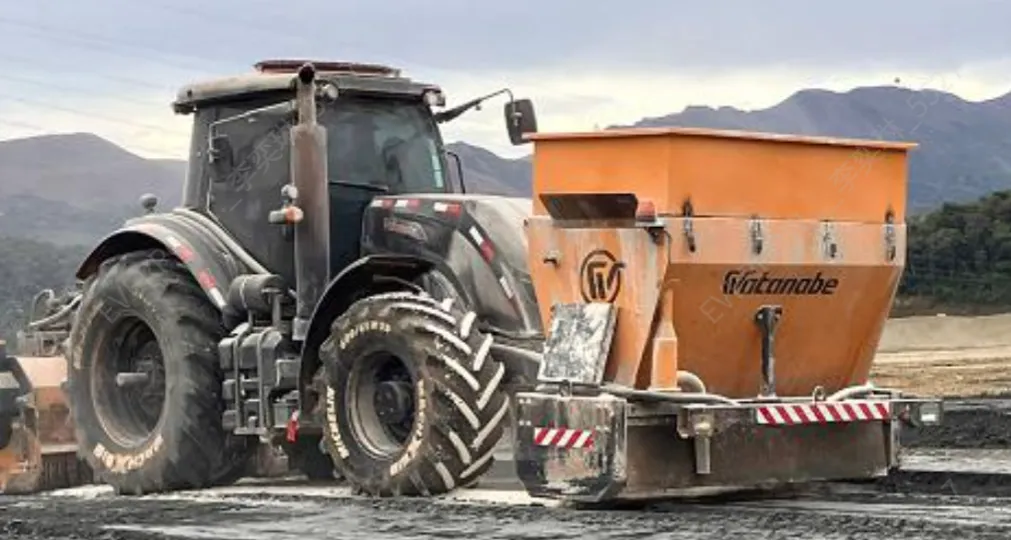
Cement is spread on the surface at the design application rate using a purpose-built binder spreader. The application rate in kg/m² is calculated from the design cement content (%), the treatment depth (mm), and the target dry density of the mixed material. Accurate spreading is essential: over-application wastes cement and can cause shrinkage cracking; under-application produces insufficient strength.
Mixing with a Soil Stabilizer Machine
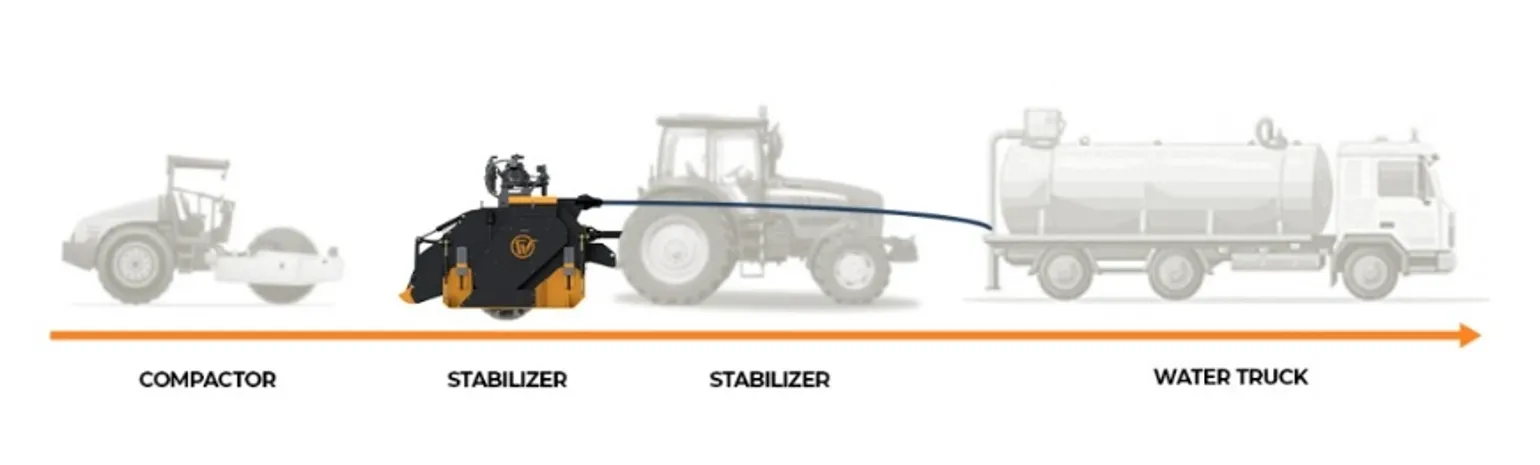
А soil stabilizer machine makes one or two passes over the surface, milling the cement and soil together to the design treatment depth. Water is added — either by the machine’s integrated spray system or by a separate water tanker — to bring the mixture to optimum moisture content. The total elapsed time from cement spreading to completion of mixing should not exceed two hours to avoid premature setting.
Grading and Compaction
The mixed layer is graded to the design profile with a motor grader and then compacted to at least 97% of maximum dry density (MDD) using a vibratory roller. Compaction must be completed within two hours of mixing — the working time window before cement hydration stiffens the mix beyond effective compaction. Density testing is carried out during and after compaction to verify compliance.
Curing
The compacted layer must be protected from moisture loss during the initial curing period — typically seven days minimum. Curing is achieved by spraying the surface with a bituminous curing membrane, covering with polyethylene sheeting, or keeping the surface damp with light water application. Without adequate curing, the surface dries too quickly and cracking occurs before the cement matrix has fully developed.
Cement Stabilization vs Lime Stabilization: Key Differences
Cement and lime are both widely used binders for soil stabilization, but they are not interchangeable. Understanding the differences determines which is correct for a given soil and project:
| Property | Cement Stabilization | Lime Stabilization |
|---|---|---|
| Primary mechanism | Cementation — CSH/CAH crystal matrix | Ion exchange + slow pozzolanic reaction |
| Best soil types | Granular soils, silts, low-PI clays | High-PI clays, Black Cotton Soil, expansive clays |
| Strength gain speed | Fast — significant strength at 7 days | Slow — peak strength at 90+ days |
| Final UCS | 1.5–5.0 MPa (depending on cement % and soil) | 0.3–1.5 MPa typical |
| Working time after mixing | 2 hours maximum — must compact within this window | 4–24 hours — longer working window |
| Effect on wet clay | Limited drying effect — wet clay must be pre-dried | Immediate drying via exothermic reaction |
| Sulphate sensitivity | Sensitive — sulphates above 0.5% can cause ettringite heave | More resistant in moderate sulphate conditions |
In practice, the most challenging soils — high-plasticity clays such as Black Cotton Soil — are often treated with a two-stage lime-cement process: lime is mixed first to immediately reduce moisture content and plasticity index, allowed to mellow for 24–72 hours, then cement is mixed in to achieve the target structural strength. This combination delivers the benefits of both binders while avoiding the drawbacks of either applied alone.

Key Design Parameters for Cement Stabilization
The following parameters must be determined during the laboratory mix design phase before any field work begins. Each has a direct impact on the strength, durability, and cost of the stabilized layer:
- Cement content (%) — Expressed as a percentage of dry soil mass. Determined by the target UCS, soil type, and traffic loading. Typical range: 3–14%. Higher cement content increases strength but also increases shrinkage cracking risk and cost.
- Target UCS at 7 days — The design strength criterion against which the mix is calibrated. IRC:SP:89 specifies 1.5–3.0 MPa at 7 days for subbase; other standards may specify 28-day UCS instead.
- Treatment depth (mm) — Determined by the structural pavement design. Shallow treatments (150–200 mm) are used for subgrade improvement; deeper treatments (250–350 mm) are used for subbase stabilization under heavy traffic roads.
- Optimum moisture content (OMC) — The moisture content at which the soil-cement mix achieves maximum dry density when compacted. Adding cement slightly increases OMC relative to untreated soil. The field moisture content at time of compaction must be within ±1.5% of OMC.
- Sulphate content of soil and water — Soluble sulphates react with cement hydration products to form ettringite, a swelling mineral that can cause heave and cracking. If sulphate content exceeds 0.5% in the soil or the mixing water, specialist low-C₃A cement or alternative treatment methods must be considered.
Frequently Asked Questions
QHow much cement is needed for soil stabilization?
Cement content is determined by laboratory mix design for each specific soil. Typical ranges are 3–5% for granular soils, 5–9% for sandy soils, and 7–14% for silts and low-plasticity clays. The required quantity in kg/m² depends on the treatment depth and target dry density. Never apply cement without a site-specific mix design — under-dosing produces insufficient strength and over-dosing wastes cost and causes shrinkage cracking.
QHow strong does cement-stabilized soil get?
A well-designed cement-stabilized soil typically achieves 1.5–3.0 MPa UCS at 7 days and 2.0–5.0 MPa at 28 days, depending on cement content and soil type. This compares to near-zero UCS for the untreated soil — a dramatic improvement. The 28-day UCS continues to increase slowly for months and years after treatment.
QWhy does cement-stabilized soil crack?
Shrinkage cracking occurs as the cement hydration process consumes water and the treated layer loses volume slightly. It is a natural consequence of cementitious bonding and is managed — not eliminated — by limiting cement content, ensuring adequate curing, and allowing the pavement surface to be applied promptly. Pre-cracking by rolling with a heavy pneumatic roller before final surfacing is a common technique to control crack location and prevent reflective cracking.
QCan cement stabilization be used on Black Cotton Soil?
Not directly. Black Cotton Soil has a very high plasticity index (typically PI > 35) which prevents effective cement mixing and reduces strength gain. The standard approach for Black Cotton Soil in India is to first apply lime to reduce the PI below 20, allow it to mellow for 24–72 hours, then mix in cement to achieve the target structural strength. This two-stage process is specified in IRC:SP:89 and is proven effective across India’s road network.
QHow long does cement-stabilized soil last?
When correctly designed and constructed, cement-stabilized subgrade and subbase layers last the full design life of the pavement — typically 20–40 years for rural roads and 30–50 years for national highways. The treated layer does not revert to its original weak state: the cementitious bonds formed during hydration are permanent.
Key Takeaways
- Cement stabilization works by forming CSH crystals that permanently bind soil particles into a rigid, cementitious matrix
- Best suited to granular soils, sands, silts, and low-plasticity clays — not suitable alone for high-PI clays or organic soils
- Target UCS for road subbase in India (IRC:SP:89) is 1.5–3.0 MPa at 7 days; typical cement content 3–14%
- Compaction must be completed within 2 hours of mixing — the hardest constraint to manage in hot Indian field conditions
- Black Cotton Soil requires lime pre-treatment before cement stabilization — a two-stage process specified in IRC:SP:89
- When correctly executed, cement-stabilized soil lasts the full 20–50 year design life of the pavement without reverting to its original weak state
Cement stabilization is a proven, cost-effective, and permanent solution for a wide range of subgrade and subbase problems across India. The key to success is a rigorous laboratory mix design, accurate binder spreading, and a soil stabilizer machine capable of delivering uniform mixing to the design depth within the compaction window. For project enquiries and equipment specifications, contact India Watanabe Soil Stabilizer Co.,Ltd today.