● Construction Techniques
What Are the Different Techniques of Stabilization?
Soil stabilization is not one technique — it is a family of construction methods, each defined by how the binder or treatment is introduced into the soil, how deeply it penetrates, and what equipment executes the work. Understanding the difference between in-situ surface mixing, deep soil mixing, pressure grouting, vibro-compaction, and other techniques determines whether your project achieves its structural and performance targets — or falls short because the wrong technique was applied to the right problem.
How Stabilization Techniques Are Classified
Stabilization techniques are most usefully classified by treatment depth — the depth below the surface to which the treatment reaches. This is the most operationally important distinction because it determines which equipment can be used, what binder delivery method is required, and what the project cost structure looks like:
| Depth Category | Depth Range | Primary Techniques | Typical Application |
|---|---|---|---|
| Surface treatment | 0–50 mm | Spray application, surface compaction | Dust control, erosion protection, crust stabilization |
| Shallow in-situ mixing | 50–500 mm | Rotary stabilizer machine, rotovator, disc harrow | Road subgrade, subbase, agricultural hardpan |
| Intermediate depth | 0.5–3 m | Trenching mixer, deep rotavator, pressure injection | Slope stabilization, retaining wall foundation, contaminated land |
| Deep treatment | 3–30+ m | Deep soil mixing, jet grouting, stone columns, vibro-compaction | Soft clay foundation, embankment on compressible ground, liquefaction mitigation |
Technique 1: In-Situ Surface Mixing
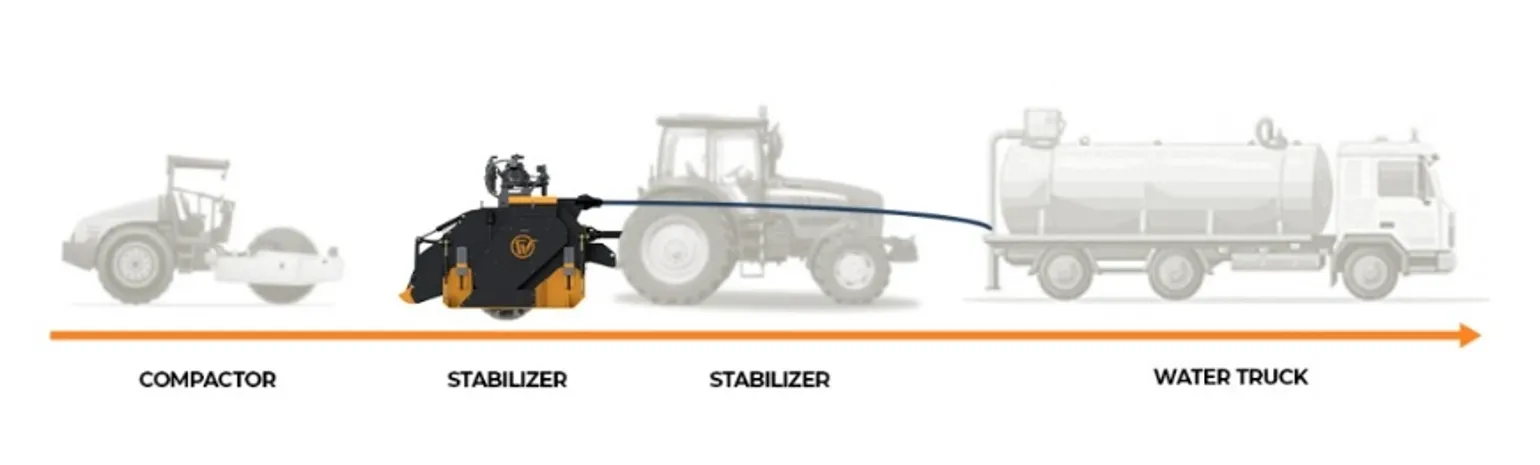
What it is: A rotary mixing machine — either tractor-mounted or self-propelled — mills the existing soil to a specified depth while simultaneously blending in a chemical binder that has been pre-spread on the surface. The mixed material is deposited back as a loose, treated layer, which is then graded and compacted.
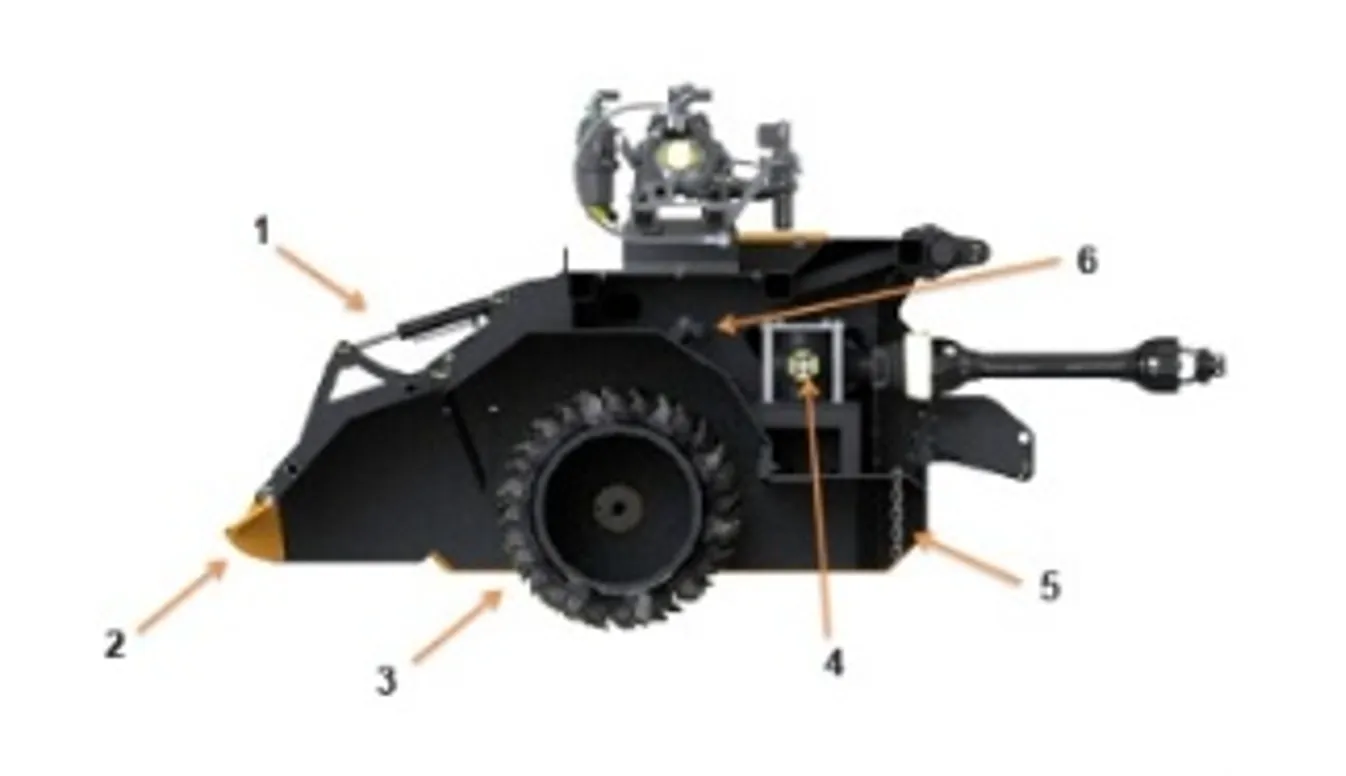
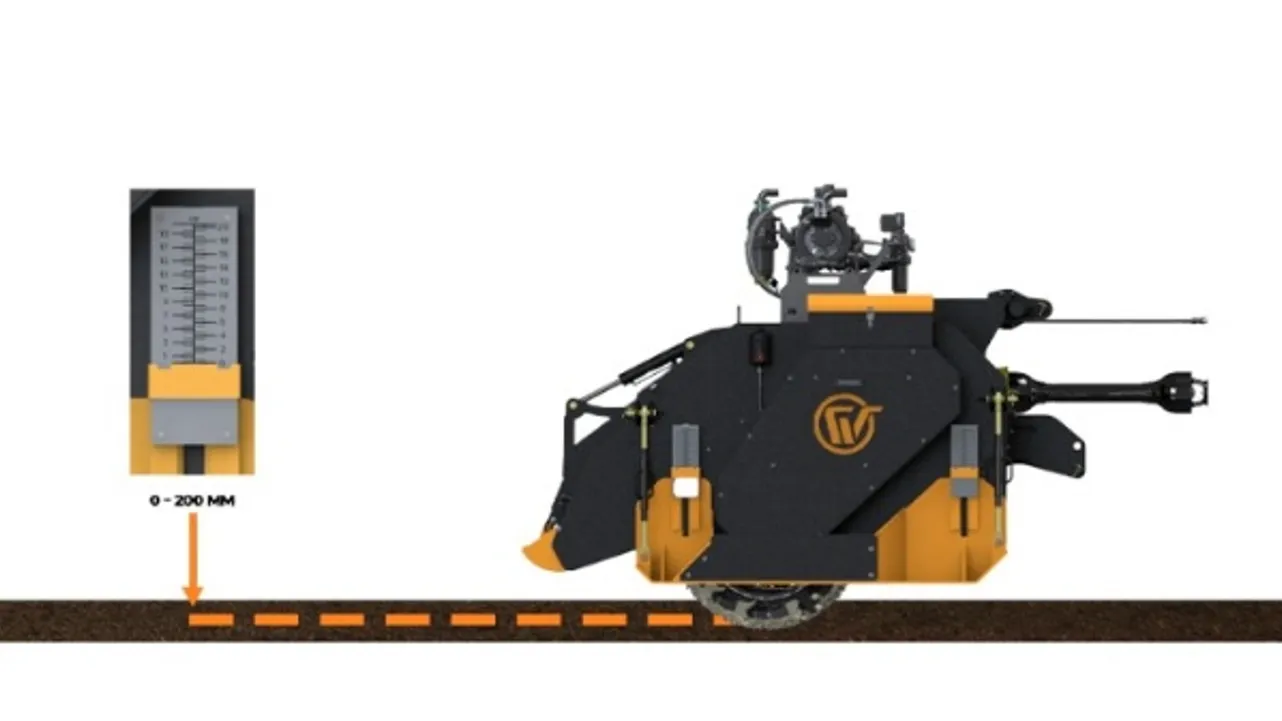
Treatment depth: 150–500 mm in a single pass, depending on machine size and power. Tractor-mounted stabilizers such as the THOR ST typically treat to 150–350 mm. Self-propelled machines can reach 500 mm.
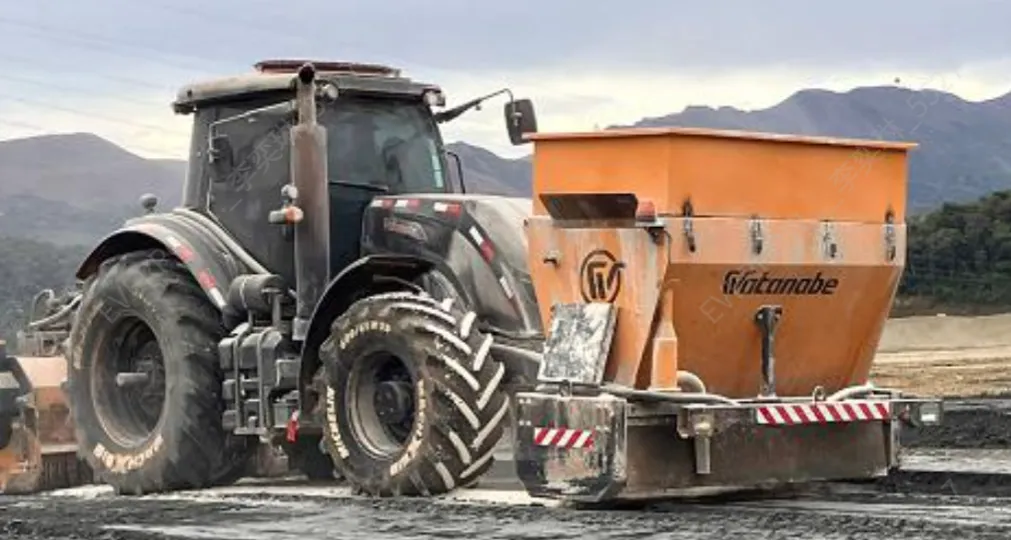
Binder delivery: Dry powder binders (cement, lime, fly ash) are pre-spread using a calibrated binder spreader. Liquid binders (bitumen emulsion, foamed bitumen, liquid chemical stabilizers) are injected directly into the mixing chamber during the machine’s pass.
Key advantages: High production rate (500–2,000 m²/day for tractor-mounted machines), no excavation required, minimal material haulage, achieves target UCS in 7 days, compatible with all chemical binders. The standard technique for road subgrade stabilization in India under IRC:SP:89.
Key constraints: Limited to 500 mm depth without multiple passes; cannot treat below existing structures; requires the treated area to be trafficable by the stabilizer machine and compaction equipment.
Typical Indian applications: National highway subgrade treatment on Black Cotton Soil (lime); rural road subbase stabilization with cement; agricultural hardpan breaking and amendment incorporation.
Production Rate Reference
A tractor-mounted stabilizer with a 2.0 m working width operating at 4 m/min forward speed treats 480 m²/hour — enough to complete 2–3 lane-km of rural road subgrade per 8-hour shift with a single machine and crew.
Technique 2: Full Depth Reclamation (FDR)
What it is: Full depth reclamation is a specific application of in-situ surface mixing applied to the rehabilitation of failed roads. The existing deteriorated pavement — asphalt surface, granular base, and subbase — is milled together to the full structural depth of the pavement, typically 150–350 mm, blended with a chemical binder, and recompacted as a new stabilized base layer. A new thin asphalt surface is then placed over the reclaimed base.
Why it is powerful: FDR eliminates the need to remove and dispose of deteriorated pavement material, import new aggregate, and build a new pavement from scratch. The existing pavement materials are the raw material for the new base — reducing both cost and environmental impact. Roads that would cost ₹80–100 lakh/km to rebuild conventionally can often be rehabilitated by FDR for ₹30–50 lakh/km.
Binder options for FDR: Cement (rigid, high strength), foamed bitumen (flexible, no shrinkage cracking), bitumen emulsion (flexible, lower strength), or cement-foamed bitumen combination (balanced). The choice depends on traffic loading, existing pavement material composition, and design requirements.
Typical Indian application: State highway and MDR rehabilitation where the existing pavement has reached end of life but the formation is sound. Increasingly specified by NHAI and state PWDs as the primary rehabilitation technique for roads with structural failure but adequate subgrade.
Technique 3: Deep Soil Mixing (DSM)
What it is: Deep soil mixing uses large-diameter augers or mixing paddles mounted on crane-supported rigs to mix cement or lime slurry into soil at depths of 3–30 m. The auger is rotated into the ground to the design depth while injecting binder slurry through ports at the auger tip, then withdrawn while continuing to mix. The result is a column of soil-cement (or soil-lime) that has significantly higher strength and stiffness than the surrounding untreated soil.
Two primary configurations:
- Wet mixing (slurry injection) — Cement or lime is mixed with water to form a slurry injected under pressure through the auger tip. Suitable for very soft, saturated soils where dry binder cannot be effectively distributed. The water in the slurry becomes part of the soil-binder mix. Produces columns of 0.5–1.5 m diameter with UCS of 0.5–5 MPa.
- Dry mixing (powder injection) — Dry binder is injected pneumatically through the auger tip. Relies on the natural soil moisture for hydration, making it suitable only for soils with sufficient moisture content. More commonly used in Scandinavia (lime columns) and Japan; less common in India due to soil variability.
Typical Indian applications: Soft clay improvement beneath embankments on reclaimed land and coastal areas (Mumbai, Chennai, Kolkata port areas); retaining wall foundation treatment; bridge abutment ground improvement; liquefaction mitigation in seismic zones.
Technique 4: Jet Grouting
What it is: Jet grouting uses high-pressure jets of cement grout (pressure: 20–60 MPa) injected through a rotating monitor lowered to the design depth via a drill hole. The jets cut through and erode the soil while simultaneously mixing and replacing it with cement grout. As the monitor is slowly withdrawn and rotated, a cylindrical column of soil-cement (called a soilcrete column) is formed.
Three jet grouting systems:
- Single fluid (S1) — Cement grout jet only. Column diameter: 0.3–0.8 m. Suitable for soft soils. Simplest and most economical system.
- Double fluid (S2) — Cement grout jet shrouded in compressed air. Column diameter: 0.6–1.5 m. More effective in dense or stiff soils.
- Triple fluid (S3) — Water jet shrouded in air cuts the soil; separate cement grout fills the cavity. Column diameter: 1.0–2.5 m. Can treat hard soils and creates largest columns. Most expensive system.
Unique capability: Jet grouting can treat ground directly beneath existing structures with minimal access — the drill hole can be as small as 130 mm diameter, allowing treatment through existing building slabs, under live traffic, and in very confined spaces. This makes it the primary technique for underpinning and emergency stabilization in built-up areas.
Typical Indian applications: Metro rail station excavation support (Mumbai, Delhi, Bangalore), heritage building underpinning, waterfront structure repair, and treatment of liquefiable deposits in seismic zones.
“
The right stabilization technique is determined by treatment depth, access constraints, and required uniformity — not by which method the contractor happens to own equipment for.
Technique 5: Compaction and Permeation Grouting
Compaction Grouting
A stiff cement-sand mortar (slump: 0–50 mm) is injected at high pressure into the soil through a casing. Unlike jet grouting (which replaces soil), compaction grouting does not mix with the surrounding soil — the grout bulb grows and densifies (compacts) the surrounding soil through displacement. This displaces and densifies loose, collapsible, or subsiding soils without excavation. Used to densify liquefiable sands beneath existing structures, to arrest ongoing foundation settlement, and to fill voids caused by sinkhole activity or underground erosion.
Permeation (Penetration) Grouting
A low-viscosity grout (cement microfine, sodium silicate, or chemical grout) is injected at low pressure, permeating through the pore spaces of a permeable granular soil without displacing or fracturing it. The grout sets in the pore spaces, cementing the sand or gravel in place. Permeation grouting is only suitable for soils with sufficient permeability to allow grout penetration (medium to coarse sand and gravel, k > 10⁻⁴ m/s). Used for cut-off walls, excavation support, and tunnel face stabilization in granular soils.
Technique 6: Vibro-Compaction and Vibro-Replacement
Vibro-Compaction
A vibrating probe (vibroflot) is inserted into loose granular soil under its own vibration and weight. The horizontal vibration liquefies the granular soil temporarily, allowing particles to rearrange into a denser packing. As the probe is slowly withdrawn, the densified column is formed. Water jetting assists probe penetration and flushes displaced fines to the surface. Vibro-compaction is only effective in loose to medium-dense granular soils with less than 15% fines content — it cannot densify clays or silts.
Vibro-Replacement (Stone Columns)
In soft clay where vibro-compaction is ineffective, the vibroflot is used to form a borehole that is then filled with compacted gravel or crushed stone as the probe is withdrawn. The resulting stone column acts as a load-transfer element and a drainage path, simultaneously increasing bearing capacity (by replacing weak clay with strong aggregate) and accelerating consolidation (by providing a radial drainage path for expelled pore water). Stone columns are typically installed in grids at 1.5–3.0 m centres, with the treated zone designed as a composite soil-column system.
Typical Indian applications: Embankment foundation improvement on soft alluvial clay in river floodplains; industrial platform construction on reclaimed land; port and harbour ground improvement.
Technique 7: Dynamic Compaction and Rapid Impact Compaction
Dynamic Compaction (DC)
A heavy steel weight — typically 5–20 tonnes — is dropped from height (10–30 m) onto the ground surface using a crane. The impact energy propagates as stress waves through the soil, densifying loose granular fills, collapsible soils, and rubble fills to depths of 3–10 m. Multiple drops at a grid pattern, followed by a final ironing pass with lighter drops, produces a uniformly densified ground surface. Dynamic compaction requires open access (the crane radius is large), generates significant vibration, and is unsuitable near existing structures or in urban areas. Primarily used on open greenfield sites with loose fill or granular soils.
Rapid Impact Compaction (RIC)
RIC uses a smaller, excavator-mounted hydraulic hammer that delivers rapid repeated impacts (40–60 blows/minute) through a flat foot onto the ground surface. It densifies granular soils to 3–5 m depth with less vibration than dynamic compaction, allowing use closer to existing structures. RIC is faster and more flexible than dynamic compaction for medium-scale projects on granular fills and is increasingly used in India for industrial platform and warehouse floor slab preparation on sandy soils.
Technique 8: Preloading and Vertical Drains
What it is: A temporary surcharge embankment — typically 2–5 m of imported fill — is placed over soft clay to apply a consolidation pressure greater than the design service load. This accelerates the expulsion of pore water from the clay, causing settlement to occur before construction rather than during and after it. The surcharge is removed once the required degree of consolidation is achieved (typically 90% primary consolidation), leaving the pre-consolidated clay stronger and stiffer than before.
Prefabricated Vertical Drains (PVDs): Natural consolidation of thick clay deposits can take years or decades because pore water must travel through the low-permeability clay to drain. PVDs — plastic band drains installed in a grid pattern — create short radial drainage paths, reducing the drainage distance from metres to centimetres and accelerating consolidation by factors of 5–20. PVD-assisted preloading can achieve 90% consolidation in 3–6 months rather than 5–20 years.
Typical Indian applications: Embankment construction on soft alluvial clay along river corridors (National Highway expansion projects); reclaimed land development in coastal cities; large industrial platform construction on deltaic deposits.
Technique Selection: Comparison at a Glance
| Technique | Depth | Soil Type | Speed | Relative Cost |
|---|---|---|---|---|
| In-situ Surface Mixing | 150–500 mm | All surface soils | Fast | Bajo |
| Full Depth Reclamation | 150–350 mm | Existing pavement + subgrade | Fast | Low–Medium |
| Deep Soil Mixing | 3–30 m | Soft clay, silt | Moderado | Alto |
| Jet Grouting | Any depth | All types, limited access | Slow | Very High |
| Compaction Grouting | Any depth | Granular, collapsible | Moderado | Alto |
| Vibro-Compaction | 5–20 m | Loose sand, gravel (<15% fines) | Fast | Medio |
| Stone Columns | 5–20 m | Soft clay, silt | Moderado | Medium–High |
| Dynamic Compaction | 3–10 m | Loose fill, granular | Fast | Low–Medium |
| Preloading + PVD | Full depth | Soft clay, compressible | Slow (months) | Bajo |
Frequently Asked Questions
QWhich stabilization technique is most commonly used for Indian road projects?
In-situ surface mixing with lime or cement using a tractor-mounted or self-propelled stabilizer machine is by far the most commonly used technique for Indian road projects — both new construction and rehabilitation. It is the technique specified under IRC:SP:89 and is appropriate for the vast majority of subgrade treatment requirements at depths of 150–350 mm. Deep soil mixing and jet grouting are used for specialised urban infrastructure and soft ground projects.
QWhat is the difference between in-situ mixing and central plant mixing?
In-situ mixing treats the soil in place — the stabilizer machine mixes binder into the existing soil without excavation. Central plant mixing (also called ex-situ or off-site mixing) excavates the soil, transports it to a mixing plant where it is blended with binder under controlled conditions, then the mixed material is transported back and compacted in layers. Central plant mixing achieves better mixing uniformity but costs 2–3 times more due to haulage and handling. It is used when the soil is too variable or contaminated for reliable in-situ treatment.
QCan deep soil mixing be used for Black Cotton Soil?
Yes — deep soil mixing with lime slurry is effective on Black Cotton Soil at depth, reducing PI and improving bearing capacity below the range of surface stabilizer machines. However, for most road subgrade and subbase applications, surface in-situ mixing to 150–350 mm depth is sufficient and far more economical. Deep mixing is used for Black Cotton Soil when the treatment depth required exceeds 500 mm — for example, under bridge abutments or large embankments.
QWhat production rate can I expect from in-situ surface mixing?
A tractor-mounted stabilizer with 2.0 m working width operating at 3–5 m/min treats 360–600 m²/hour. With a full shift of 7 productive hours, a single machine can treat 2,500–4,200 m²/day — equivalent to 1.25–2.1 lane-km of single-lane rural road. Actual production depends on soil conditions, binder application logistics, water availability, and compaction equipment availability.
QWhen is jet grouting preferred over deep soil mixing?
Jet grouting is preferred when access is very restricted (treatment must be done through existing slabs or in confined spaces), when the soil is too dense or stiff for auger penetration, or when very precise column geometry is required (e.g. for cut-off walls). Deep soil mixing is preferred when access allows large rig operation, when production rate is important, and when a full soil-cement mass (rather than discrete columns) is required for large-area improvement.
Key Takeaways
- Stabilization techniques are classified by treatment depth: surface (0–50 mm), shallow in-situ (50–500 mm), intermediate (0.5–3 m), and deep (>3 m)
- In-situ surface mixing is the dominant technique for Indian road projects — lowest cost, highest production rate, specified under IRC:SP:89
- Full depth reclamation rehabilitates failed pavements at 30–50% of conventional rebuild cost by reusing existing materials in place
- Deep soil mixing and jet grouting are specialist techniques for depths beyond the reach of surface machines — used for soft clay, urban infrastructure, and confined access sites
- A tractor-mounted stabilizer treats 2,500–4,200 m²/day — enough for 1.25–2.1 lane-km of rural road subgrade per shift
Selecting the right stabilization technique is as important as selecting the right binder. The THOR ST Soil Stabilizer from India Watanabe Soil Stabilizer Co., Ltd. executes the in-situ surface mixing technique — the most productive, most cost-effective, and most widely specified technique for road subgrade treatment, subbase rehabilitation, and agricultural land improvement across India. Contact our team to discuss which technique and equipment combination is right for your project depth and soil conditions.